
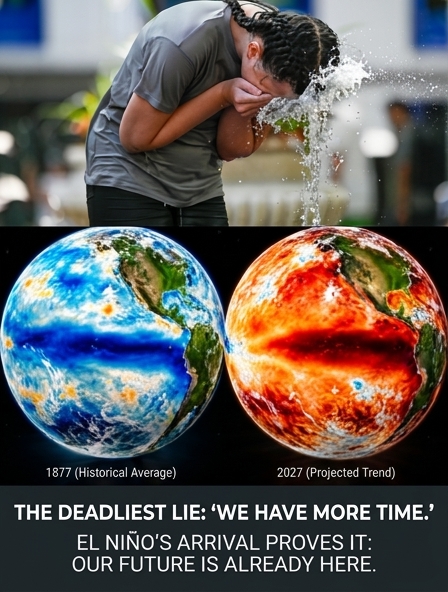
The illusion that humanity has “more time” to address climate change has long served as a comforting falsehood, but recent scientific and environmental developments are shattering that myth. As the planet’s most intense El Niño event on record unfolds, experts warn that the window for meaningful action has slammed shut — and what lies ahead is far more catastrophic than most realize.
Adam McKay, director of the sobering film Don’t Look Up, recently pointed out a troubling truth: the most insidious lie isn’t just fringe climate denial but the respectable myth of “Net Zero by 2050.” It’s a promise of distant, vague deadlines—24 years from now—acting as a rhetorical buffer, delaying urgent action. Meanwhile, global leaders and institutions continue to label alarmist anyone who pushes for immediate change, and too often, climate crisis discussion remains hidden behind polite silence or vague promises.
But reality has a way of catching up. In San Juan, Puerto Rico, approximately half a million residents are enduring 48-hour water outages amid the driest July in over a century. Across the Atlantic, England and Wales are experiencing their driest July on record, with over twenty million residents banned from using garden hoses. These localized crises are symptoms of a larger, systemic predicament: the Earth is warming at an unprecedented pace, and time is running out.
Sir David King, a former British government science adviser, warned back in 2021 that the next three to four years are critical for humanity’s survival. Yet, that window *closed* last year, as the planet’s temperature has stubbornly hovered above the 1.5°C threshold—an essential limit set by the Paris Agreement—and oceans reach their hottest levels ever recorded.
Current data reveal a frightening reality: every second, Earth traps enough heat to equal about twelve Hiroshima bombs, a stark rise from just five or six bombs’ worth in 2020. The acceleration of this heat imbalance means that what was once considered a worst-case scenario is now rapidly becoming the norm.
Significantly, the Pacific Ocean is currently hosting a record-breaking El Niño, which scientists say pushes the odds of 2027 becoming the hottest year ever recorded by over 80%. This is not just a one-year anomaly; it’s a harbinger of more extreme heat, rising sea levels, and worsening climate disasters to come.
Risk analysts and climate researchers warn that if global warming reaches two degrees Celsius above pre-industrial levels by 2050, it could result in as many as two billion deaths—an extraordinary figure that underscores the severity of the crisis. The next level, three degrees Celsius, could push that death toll to four billion, yet, alarmingly, there are no comprehensive plans currently in place to prevent this trajectory.
Dishearteningly, the Biden administration’s approach has involved removing references to “climate change” from federal websites and downplaying the ongoing crisis as isolated incidents rather than interconnected phenomena. Meanwhile, global denial and complacency persist despite the mounting evidence.
The only global leader still sounding the alarm is UN Secretary-General António Guterres, warning that “El Niño is strengthening, adding fuel to a planet already on fire.” His words echo the urgent reality: we are out of time. Not in some distant future—right now.
It’s time for voters to demand accountability. Set one clear condition this fall: no vote until political candidates openly acknowledge the climate emergency and commit to tangible actions starting immediately. Because, as Adam McKay puts it plainly, “we are out of time.” The choice is ours: act now or face a future defined by devastation.
Where to Learn More
- Global climate impacts are getting worse, Sir David King warns – COP26 News
- UN Secretary-General António Guterres statement on climate change – United Nations
- Climate Forecasts and Science – Environmental Defense Fund
- Earth’s Warming Accelerates to Record Levels – Nature