
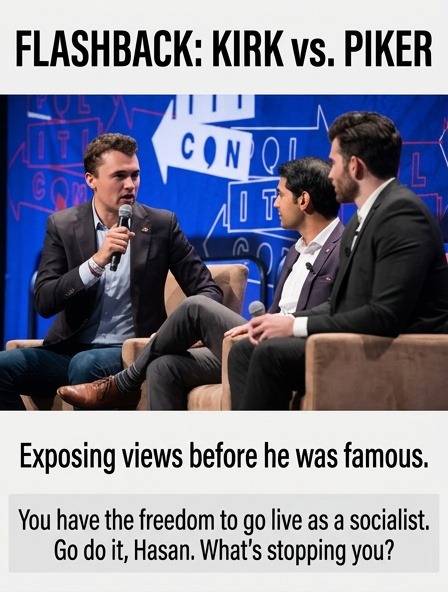
In the world of political commentary and online streaming, few figures have sparked as much controversy as Hasan Piker. Known today as a prominent far-left streamer and social media influencer, Piker has amassed millions of followers by championing progressive policies and critical takes on capitalism. But long before he became a household name, Piker was confronted in a notable political setting—a moment that’s resurfaced on social media and is now being revisited for its provocative insights.
The scene takes place at Politicon 2018, a convention known for bringing together political commentators from across the spectrum. At the time, Charlie Kirk, a staunch conservative activist, and founder of Turning Point USA, was already well-known for his outspoken conservative stance and spirited debates. During the event, Kirk took a rare opportunity to directly challenge Piker, who at the time was still emerging as a prominent voice among progressive online circles.
In a moment captured in a now-viral clip, Kirk calls out Piker with a pointed challenge, asking:
“You have the freedom to go live as a socialist. Go do it, Hasan. What’s stopping you?”
This bold remark underscored Kirk’s skeptical view of Piker’s ideology, implying that Piker had no real barriers preventing him from openly advocating for socialism. The comment also encapsulates the broader divide between conservative and progressive viewpoints, and it’s striking to see how these early exchanges hint at the rise of Piker as a formidable social media personality.
At the time, Piker’s response was relatively subdued compared to today’s more confrontational online persona, but the moment itself sheds light on how his views were already drawing attention. Despite Kirk’s challenge, Piker was largely operating within niche internet spheres then, but within a few years, he would turn into a mainstream figure, thanks in part to his engaging streams, witty commentary, and large online following.
Fast forward to today, and Piker’s name is often associated with fiery debates on social media, specific policy proposals, and progressive activism. Yet, that 2018 Politicon encounter reminds us that his political identity was evident well before his rise to internet fame. Charlie Kirk’s challenge also underscores the persistent ideological battles that continue to shape American politics—battles that are fought as much in the digital realm as in traditional media.
While Piker has evolved significantly since then, that early moment of exposure illustrates how figures can grow from contentious beginnings into influential voice on the national stage. It also highlights the importance of recognizing the roots of public figures and how their past confrontations and debates can offer insight into their current roles and perspectives.