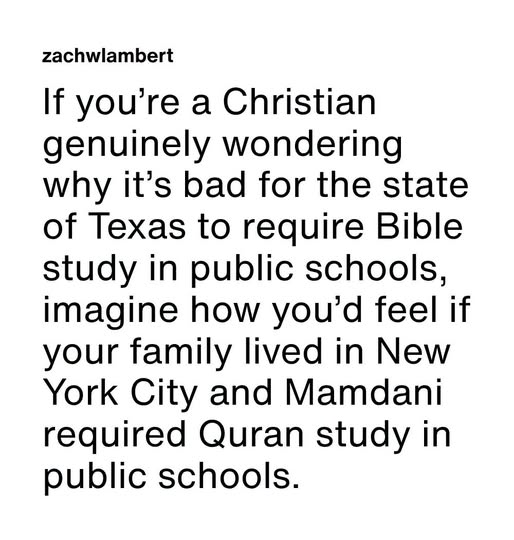
In recent weeks, a social media post by user zachwlambert has ignited a heated national conversation about the role of religion in public education. The post, which includes an image of text questioning the implications of requiring Bible study in Texas public schools, asks a provocative question: “If you’re a Christian genuinely wondering why it’s bad for the state of Texas to require Bible study in public schools, imagine how you’d feel if your faith and beliefs were marginalized or dismissed.”<\/em>
This statement resonates with many who see the inclusion of such religious coursework as a potential violation of the separation of church and state, a principle enshrined in the First Amendment of the U.S. Constitution. However, supporters argue that teaching about the Bible in schools can serve an educational purpose, providing insights into literature, history, and culture, especially given the influence of Christianity on Western civilization.
The debate over religious instruction in public schools is not new, but recent legislative moves in Texas have brought it back into headlines. Some state lawmakers have introduced bills aiming to incorporate Bible courses as part of standard curricula, claiming that such lessons will promote moral values and cultural literacy. Critics counter that these measures risk blurring the line between church and state, raising concerns over potential proselytizing and the marginalization of students from diverse religious backgrounds or those with no faith.
Educational experts warn that, even with the best of intentions, including religious texts in public school curricula can create divisions among students. “Public schools should remain neutral on matters of religion,” says Dr. Emily Carter, a constitutional law professor at Harvard University. “Introducing specific religious teachings without proper context risks entangling government with religious doctrine, which can lead to legal challenges and undermine the core principle of religious freedom.”
On the other side, some parents and community members argue that understanding the Bible is essential to comprehending Western history and literature. They stress that such classes can be taught from a secular perspective, focusing on historical context and literary analysis rather than religious indoctrination. Florida, for example, faced similar debates when contemplating the inclusion of Bible courses in public schools, and some districts have moved cautiously to navigate this complex issue.
The viral social media post underscores a broader societal debate: How do we balance religious education, freedom of speech, and the neutrality of public institutions? As Texas considers further legislation on this matter, the coming months could determine whether similar policies will spread across other states or whether legal challenges will restrict their implementation.
Ultimately, the conversation reflects deeper questions about cultural values, the role of religion in public life, and the rights of students to an inclusive education free from religious pressure. As the nation watches Texas’s approach, it underscores the importance of safeguarding the principles that ensure a diverse and equitable educational system for all.