
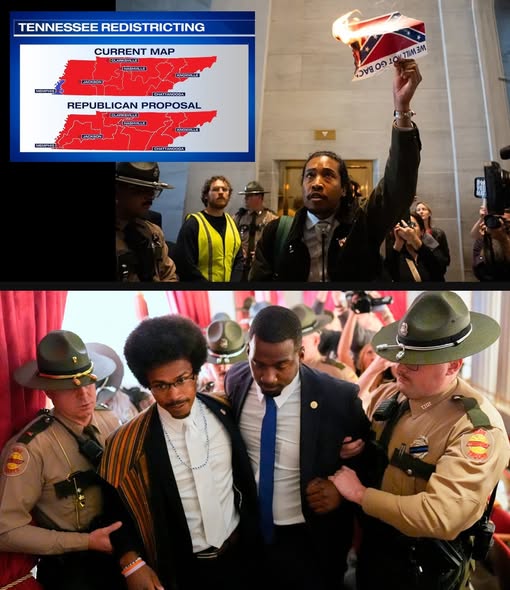
In a swift and controversial move, Tennessee’s Republican supermajority has enacted one of the most brazen redistricting efforts in recent memory, sparking widespread protests and fierce accusations of racial gerrymandering. The process, carried out at lightning speed, involved repealing a longstanding law that barred mid-decade redistricting and altering legislative rules to curtail public comment, effectively silencing opposition voices during the process.
These rapid changes allowed the GOP-controlled legislature to redraw district boundaries in a way that significantly impacts Memphis, a majority-Black city. The new map splits Memphis across three separate congressional districts, strategically diluting the political influence of hundreds of thousands of Black voters. Critics argue that this maneuver amounts to a political attempt to undermine minority representation, reminiscent of the oppressive “three-fifths compromise” that historically devalued Black lives.
Rep. Justin Pearson, a vocal critic from Memphis, bluntly described the redistricting as “an attempt to have a new three-fifths compromise, to count the bodies for representational participation in Congress but deny the agency and humanity.” During an fiery session on the House floor, Pearson condemned the process as a sham conducted in secrecy and behind closed doors, with backroom deals orchestrating the outcome.
The tension on the chamber floor was palpable. Rep. Justin Jones took a visceral stand against the GOP supermajority by handing a printout of a Confederate flag directly to the House Majority Leader, calling the Republican caucus the “white sheet caucus.” He then took the symbolic act further, walking into the hallway and burning another Confederate flag in front of protesting citizens. His actions underscored the emotional and racial undertones fueling the controversy.
Another powerful moment unfolded as Pearson was involved in a heated physical confrontation with state troopers who were clearing protesters. He yelled at an officer, saying, “you better let go of him,” before declaring, “this is what tyranny does, this is what white supremacy does.” These words highlighted the deep frustrations of those opposing the partisan manipulation of district boundaries.
Despite being vastly outnumbered, Democratic lawmakers fought with resolve, emphasizing that their efforts were about protecting voting rights and resisting racial gerrymandering. Sen. London Lamar summed up the sentiment poignantly: “You cannot take a majority Black city, fracture its voting power and then tell us race has nothing to do with it.” Her statement resonates in a chamber where racial justice is at the heart of the debate.
Experts and activists argue that this latest redistricting effort symbolizes more than politics—it’s a reflection of ongoing racial tensions and power struggles in Tennessee. Critics warn that such moves undermine democracy and threaten the political voice of marginalized communities, prompting calls for federal oversight and reform.
As the dust settles, the fight over Tennessee’s redistricting underscores the intense struggles over racial representation and voting rights happening nationwide. The question remains: will this recent power grab lead to lasting change or ignite further resistance?
Where to Learn More
- Tennessee Redistricting Sparks Protests and Outrage – NPR
- Gerrymandering in Tennessee: A Deep Dive – The Washington Post
- Tennessee Legislature Faces Backlash Over Racially Charged Redistricting – The New York Times
- US States Redraw Districts, Sparking Racial Outrage – BBC News