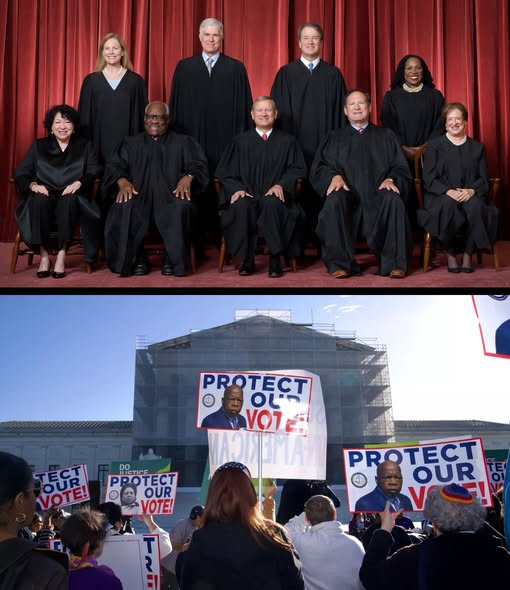
The Supreme Court delivered a seismic blow to voting rights yesterday, reinforcing concerns about the erosion of protections for voters of color and minority communities nationwide. In a 6-3 decision authored by Justice Samuel Alito, the conservative supermajority struck down key provisions of the **Voting Rights Act of 1965**, especially *Section 2*, which has historically been a critical tool in combating racial discrimination in redistricting.
The case, Louisiana v. Callais, resulted in the Court effectively dismantling the longstanding legal framework that required states to prove *intentional discrimination* to challenge racially gerrymandered districts. Justice Elena Kagan sharply dissented, warning that the ruling has rendered the law “*all but a dead letter*.” The decision has immediate and far-reaching implications, with advocates warning that it opens the floodgates for unchecked racial discrimination in electoral maps.
Less than 24 hours after this ruling, Louisiana’s Governor Jeff Landry made a startling move: he announced the cancellation of the state’s upcoming May 16 U.S. House primaries. The reason? To allow Republican-led redistricting efforts to redraw electoral boundaries in a way that could potentially eliminate one of Louisiana’s two Black-represented districts. This is happening despite the fact that early voting had already commenced, ballots had been mailed, and voters had begun casting their ballots.
In an alarming pattern of rapid political maneuvering, the response was swift from political leaders across the country. Former President Donald Trump, on his platform Truth Social, expressed gratitude to Landry for “moving so quickly,” seemingly celebrating this assault on voting rights. Meanwhile, Florida Republicans quickly passed a new gerrymander within an hour of the ruling, and Tennessee officials were reportedly pushing to redraw Memphis out of existence altogether — all before the ink was dry on the Supreme Court’s decision.
This fast-paced and coordinated response highlights what critics are calling a *full-scale attack on democracy*. The NAACP Legal Defense Fund condemned the ruling as “abominable” and warned that, under the new legal landscape, states could openly discriminate “with impunity,” undermining generations of efforts to combat racial disenfranchisement.
The implications are clear: the playbook from the political right is in plain sight, and the stakes could not be higher for the future of voting rights in America. With early voting underway and ballots already cast in Louisiana, efforts to undo or delay elections are raising profound concerns about the integrity of the democratic process.
Democrats and voting rights advocates are warning that this is not just a legal or political battle — it’s a crisis of democracy itself. They are urging elected officials, organizers, and everyday voters to recognize the gravity of the situation and to mobilize efforts *in the streets, in courts, and on the airwaves*. The question remains: will those in power fight with the urgency and vigor needed, or will they let this moment slip into history as another chapter of democratic decline?
This is a defining moment: the fight to protect voting rights and uphold justice is accelerating, and it demands full-scale resistance. The time for complacency is long past.
Where to Learn More
- Supreme Court Guts Voting Rights Law in Ruling that Sparks Backlash — The New York Times
- NAACP Legal Defense Fund Condemns Supreme Court Decision — NAACP
- Analysis: How the Supreme Court’s Ruling Changes Voting Rights Landscape — The Washington Post
- The Guardian: Supreme Court’s Voting Rights Ruling Sparks Fear and Outrage