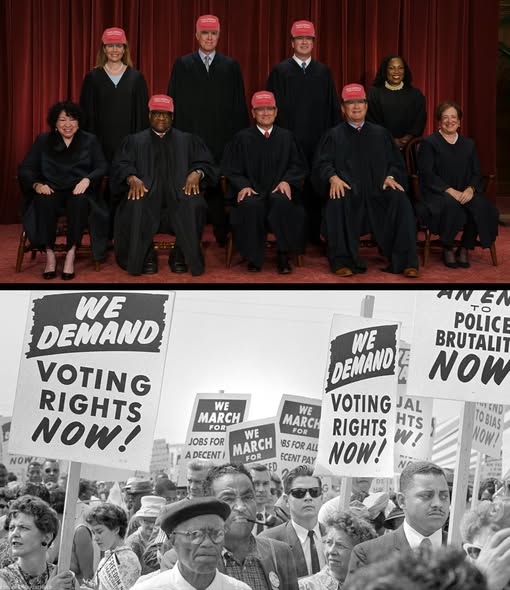
The Supreme Court delivered a shocking blow to voting rights today with a 6-3 decision in Louisiana v. Callais, effectively crippling Section 2 of the Voting Rights Act — a cornerstone of civil rights that historically dismantled Jim Crow laws and fought racial discrimination in voting.
The ruling, authored by Justice Samuel Alito, reversed longstanding legal standards by redefining how courts evaluate claims of racial discrimination in electoral maps. Under the new interpretation, partisan gerrymandering — the practice of redrawing districts to gain political advantage — can now be used as a defense against allegations of racial bias. In plain language, politicians can now craft electoral maps that dilute the voting power of communities of color, as long as they label these manipulations as a matter of political strategy.
This decision raises alarming implications for voting rights nationwide. Experts warn that Republican-led states like Florida, Alabama, and South Carolina are already eyeing the ruling as a green light to redraw districts in a way that favors their party, potentially handing the GOP as many as 19 additional House seats in the 2024 elections. The NAACP Legal Defense Fund responded sharply, asserting that the ruling permits states to “discriminate with impunity.”
While the decision may seem technical, the real-world consequences are stark and immediate. The ruling effectively removes a critical legal safeguard that protected communities of color from racial gerrymandering — a tactic historically used to silence marginalized voters and entrench racial disparities in representation.
This legal setback coincides with other troubling developments. Today, Florida’s legislature passed a new electoral map explicitly crafted to maximize Republican advantage, while the federal government under the current administration has moved to strip protections for millions of immigrants—a move that some see as part of a broader pattern of reducing safeguards for marginalized groups.
Voting rights advocates traditionally warned that removing guardrails in electoral law would embolden partisan and racial discrimination. Now, with the Supreme Court’s latest ruling, many fear that the window for fair representation is closing even tighter. The question remains: What comes next for American democracy? The answer is uncertain — and that uncertainty itself poses a profound challenge to voters, activists, and legal defenders alike.
One thing is clear: As the fight for voting rights intensifies, this ruling underscores the urgent need for legislative action and renewed legal protections. The coming months will determine whether voting rights and racial justice can withstand this conservative push or if suppression will cast a longer shadow over U.S. elections.
Where to Learn More
- NAACP Legal Defense Fund responds to Supreme Court ruling – NAACP Legal Defense Fund
- Analysis of Louisiana v. Callais decision and implications for voting rights – The New York Times
- Brennan Center: How the Supreme Court’s new ruling reshapes voting rights landscape – Brennan Center for Justice
- Impact of the ruling on upcoming elections in Florida, Alabama, and beyond – CNN