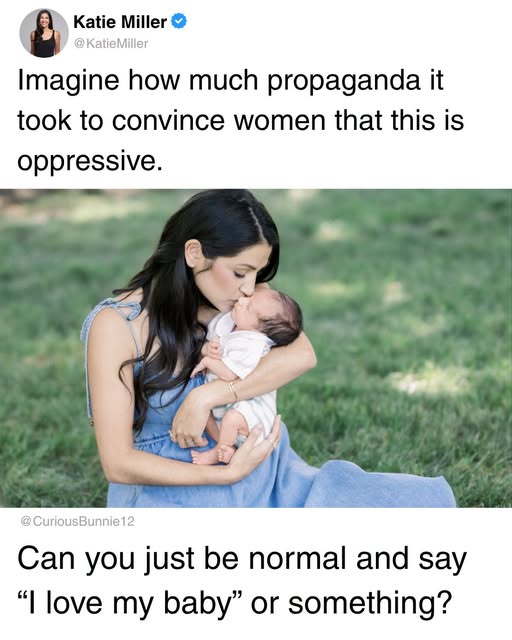
In recent days, a viral social media post has ignited a heated debate about societal perceptions of women and the narratives that shape them. The post features an image of a baby alongside a provocative caption from Twitter user Katie Miller (@KatieMiller) that questions how much propaganda might have been necessary to convince society that certain traditional roles or behaviors associated with women are oppressive.
The tweet questions, “Imagine how much propaganda it took to convince women that this IS women oppressive.” Below her post, a comment from CuriousBunnie12 challenges what many perceive as societal expectations: “Can you just be normal and…” The exchange has struck a chord, resonating with both supporters and critics, and sparking widespread discussion about gender norms, societal conditioning, and individual authenticity.
Many users interpret the post as a critique of how media, culture, and historical narratives have influenced perceptions of what it means to be a woman. Some argue that societal expectations—ranging from dress codes and career choices to societal behaviors—are subtly ingrained through pervasive propaganda that defines ‘correct’ femininity. Others see it as a provocative call to re-examine accepted norms and embrace personal authenticity instead of conforming to stereotypical roles.
Responses to the tweet have been polarizing. Supporters claim that challenging ingrained narratives is a necessary step toward true gender equality and personal freedom. They suggest that many societal expectations placed on women are constructs designed to maintain particular power dynamics. Critics, however, see the message as dismissive of genuine struggles women face and argue it oversimplifies complex issues surrounding gender roles and societal progress.
This social media moment highlights a broader cultural debate: How much of our understanding of gender roles is influenced by unconscious bias and media-driven propaganda? Are traditional roles inherently oppressive, or do they serve as personal choices for many? The discussion opens the door for a reevaluation of stereotypes, expectations, and the importance of personal choice in defining one’s identity.
As with many viral topics, this conversation underscores the power of social media to challenge, provoke, and shape public discourse. Whether one agrees or disagrees with Miller’s provocative assertion, it undeniably sparks a necessary dialogue about societal conditioning, gender norms, and the importance of authenticity in a rapidly evolving cultural landscape.