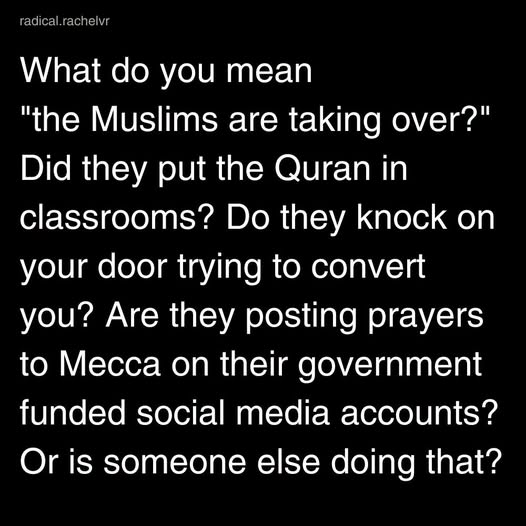
Recently, a social media post has ignited controversy and widespread confusion about the Muslim community’s role in public education. The post, attributed to user radical.rachelvr, questions whether Muslims are “taking over” by suggesting they are planting religious texts in classrooms or attempting to convert students through door-to-door efforts. This viral message has prompted many to reflect on misconceptions surrounding Islam and the misconception that Muslim communities are expanding their influence in ways that threaten secular education.
The original post features an image with the text: “What do you mean the Muslims are taking over? Did they put the Quran in classrooms? Do they knock your door trying to convert you? Are they pose”. The message appears to express suspicion about Muslim activities, fueling fears often rooted in misinformation and stereotypes.
In reality, the presence of religious texts like the Quran in public schools is a transparent reflection of increasingly diverse student populations. Many school districts incorporate multicultural and religious literacy programs to foster understanding and respect for different cultures. These initiatives are often designed to promote inclusiveness, not to promote religious conversion. The Quran, along with other religious texts, may be used in academic settings—such as history or religious studies classes—to provide students with a broader understanding of world religions.
It is crucial to distinguish between misconceptions and facts. For instance, public schools in the United States are governed by strict laws that prohibit proselytization and attempts to convert students. Teachers are expected to maintain neutrality and present religious content in an educational, rather than religious, context. The notion that Muslims are “knocking on doors” attempting to convert others is also a misconception; those activities are associated with various missionary groups and are not linked to Muslim communities or practices.
Islam, like other major religions, is practiced by millions around the world who primarily seek spiritual fulfillment and community. The recent social media discourse often conflates the actions of a few with entire communities, leading to dangerous stereotypes and misinformation. Experts agree that fostering understanding through education and factual information is essential to combat hostility and prejudice.
While social media can amplify fears and misconceptions, it’s vital for the public to seek accurate information. Recognizing the differences between fact and sensationalism helps foster a more inclusive society—one that respects religious diversity while upholding secular values.
Where to Learn More
- Pew Research: The State of Religious Diversity in America – Pew Research Center
- Religion in Public Schools: Myths and Facts – Anti-Defamation League
- Islam Facts and Myths Explained – Study.com
- Religion in Public Schools – NCSL – National Conference of State Legislatures