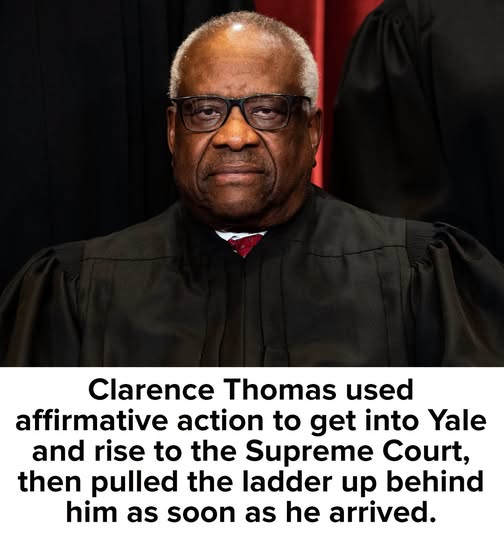
A viral social media post controversially claims that Supreme Court Justice Clarence Thomas leveraged affirmative action to gain admission to Yale University and then ascended to the nation’s highest court, allegedly without “pulling the ladder up” behind him—until now.
The image, widely circulated across platforms like Twitter and Facebook, features bold text asserting: “Clarence Thomas used affirmative action to get into Yale and rise to the Supreme Court, then pulled the ladder up behind him as soon as he arrived.” This provocative statement has ignited a flurry of discussions, debates, and comparisons about the role of affirmative action, judicial philosophy, and perceptions of systemic inequalities within America’s elite institutions.
Context and Background
Clarence Thomas’s educational journey has long been a topic of interest in political and legal circles. He attended Conception Seminary College before earning his undergraduate degree from Holy Cross College, followed by his law degree from Yale Law School in 1974—an institution known for its competitive admissions process.
Supporters argue that Justice Thomas’s rise exemplifies individual achievement, emphasizing his remarkable career trajectory from modest beginnings to one of the most powerful judicial positions in the country. Critics, however, suggest that his admission to Yale may have been facilitated by affirmative action policies designed to diversify America’s Ivy League campuses.
The social media post has reignited this debate, with some users claiming that Justice Thomas’s success is evidence of how affirmative action can provide opportunities for underrepresented minorities. Others contend that such narratives oversimplify complex issues of merit, opportunity, and systemic inequality.
The Broader Implications
The controversy underscores ongoing political and cultural tensions surrounding affirmative action. While proponents argue that these policies help level the playing field for historically marginalized groups, opponents argue they can sometimes lead to perceptions of unearned advantages or undermine merit-based achievement.
Justice Thomas himself has been a vocal critic of affirmative action, often emphasizing the importance of individual merit over group identity. His critics, however, see this as a potential contradiction, and the viral post seems to question whether affirmative action was a stepping stone or a barrier in his path to the Supreme Court.
Legal and academic experts note that the debate is complicated. Admissions decisions are multifaceted, and while race can be a factor, it’s rarely the sole criterion. Furthermore, the narrative that ties personal success entirely to affirmative action overlooks the myriad of other factors—hard work, perseverance, and opportunity—that contribute to such achievements.
Ultimately, the viral post exemplifies the ongoing polarization and the way social media serves as a battleground for these contentious issues. It highlights how perceptions of privilege, merit, and systemic fairness continue to shape public discourse about the judiciary and elite institutions.
Where to Learn More
- Clarence Thomas: A Life in the Supreme Court – The New York Times
- The Role of Affirmative Action in Justice Thomas’s Rise – Politico
- Debunking Myths About Affirmative Action – Brookings Institution
- A Critical Look at Clarence Thomas’s Background – CNN