
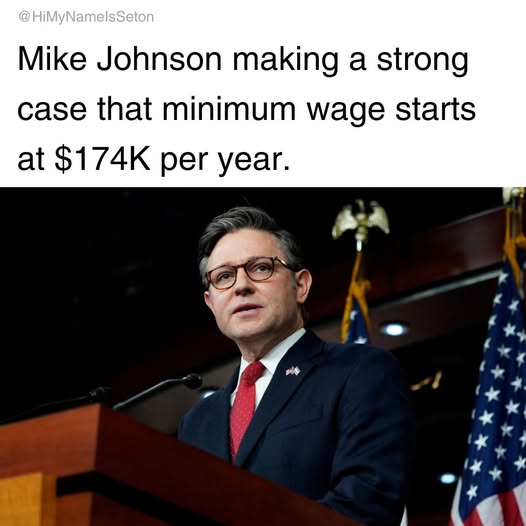
An eye-catching image circulating on social media—featuring a bold statement that the minimum wage should begin at a staggering $174,000 per year—has sparked both debate and confusion online. The post, attributed to the account @HiMyNamelsSeton with a caption seemingly endorsing the figure, has quickly gone viral, prompting questions about its legitimacy and the underlying economic logic.
At first glance, the claim appears to be a satirical or hyperbolic take on the ongoing discussions about fair wages and economic inequality. However, some viewers have taken the figure at face value, leading to a surge of speculation about what such a minimum wage would entail and whether it’s grounded in any real economic analysis. The juxtaposition of a figure so vastly above current U.S. minimum wages—currently ranging from $7.25 to $15 per hour depending on the state—has undeniably captured public attention.
Understanding the Context
It’s important to recognize that $174,000 per year roughly translates to an hourly wage of about $83.65 based on a standard 40-hour workweek. This figure is significantly higher than the median household income in the United States, which hovers around $70,000. Setting a minimum wage at such a level would represent an enormous shift in economic policy—one more typical of highly developed, high-income economies or perhaps a satirical exaggeration intended to provoke thought about income disparities.
Is the Claim Realistic?
Economists and labor experts widely agree that a minimum wage of $174,000 is neither practical nor feasible without profound changes to the economy, productivity, and cost of living. Such a policy would invariably lead to widespread business closures, inflation, and shifts in employment patterns—making it unlikely to be a serious proposal. Instead, many interpret this viral image as a form of social commentary or satire, highlighting the gap between current wages and what many believe would be a fair living wage.
It’s not uncommon for social media users to share exaggerated or humorous content to spark conversation about economic issues. The post’s virality underscores the urgency many feel about economic inequality, even if the figures themselves aren’t intended to be taken literally.
Public Reaction and Debate
Replies to the post have ranged from laughter and skepticism to serious discussions about wage policy reform. Some users argue that a wage of $174,000 would eliminate poverty, while others point out how unrealistic such figures are under current economic frameworks. Experts caution that setting minimum wages dramatically above the market rate could have unintended consequences, including inflation and decreased employment opportunities for low-skilled workers.
What’s Next?
While the viral image is likely meant to be provocative or satirical, it has succeeded in reigniting conversations about living wages and economic justice. As debates over minimum wage policies continue across the U.S., it remains essential to rely on credible data and consult economic research rather than viral social media claims for grounded policy discussions.