
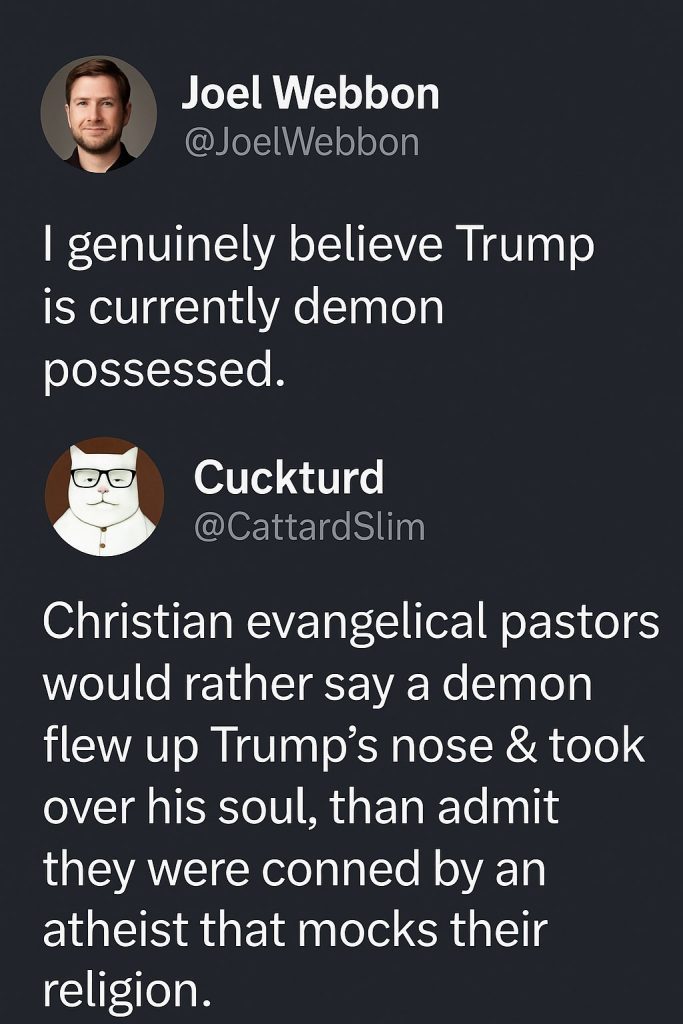
The latest viral topic on social media is stirring controversy and sparking heated discussions across various online platforms. Joel Webbon, a vocal social media figure, shared a provocative opinion that Donald Trump, the former US president, is “currently demon possessed.” This statement has ignited a firestorm of responses, highlighting the growing polarization around religious and political discourse in America.
Joel Webbon’s Controversial Claim
In a tweet that rapidly gained traction, Joel Webbon boldly declared his belief that Donald Trump is under demonic influence. His message read, “Joel Webbon genuinely believe Trump is currently demon possessed,” followed by commentary critiquing certain evangelical pastors who appear reluctant to label Trump with such terms.
This remark touches a nerve in a nation where religion and politics deeply intersect. Many evangelical Christian leaders have been vocal supporters of Trump, often framing his political mission in spiritual terms. Webbon’s direct challenge to this narrative has sparked backlash, with supporters viewing it as an attack on their faith and political identity.
The Role of Evangelical Pastors and Political Endorsements
Evangelical pastors wield significant influence in US politics, particularly within the Republican base. Their endorsement of Trump in 2016 and subsequent elections helped solidify a crucial voting bloc. However, some observers and critics argue that the merging of religious leadership with partisan politics can lead to contentious theological claims and dogmas.
By accusing pastors of avoiding the label “demon possessed” despite controversial behaviors attributed to Trump, Webbon highlights an ongoing debate about accountability and the boundaries of spiritual rhetoric. This debate is not new, but Webbon’s forthright language has brought it back into the spotlight.
Public Reactions and the Impact on Political Discourse
The tweet prompted a mixed flood of reactions. Some users applauded Webbon’s courage to speak out against what they see as dangerous idolization of political figures. Others condemned his words as disrespectful, incendiary, and inflammatory.
“Using spiritual terms to attack political opponents only deepens divisions,” said one commentator. “It distracts from real policy discussions and plays into culture wars.”
Meanwhile, many evangelical supporters doubled down on their support, dismissing the idea of “demon possession” as political propaganda or satire. This clash illustrates how deeply entwined faith and politics have become in American public life, often leading to volatile exchanges.
Why This Matters
The viral nature of Webbon’s comments sheds light on broader societal challenges: the intersection of religion, politics, and social media. Platforms like Twitter amplify fringe or provocative ideas rapidly, often without the nuance required for complex issues.
As the US approaches another presidential election cycle, the role of religious rhetoric in political messaging will likely continue to be a flashpoint of controversy. Webbon’s tweet serves as a reminder of how faith-based claims can influence political narratives and public perception, sometimes escalating conflicts rather than encouraging dialogue.
Whether one agrees or disagrees with Joel Webbon’s assertion, the conversation it sparks about spiritual accountability, political loyalty, and the power of words in social media is undeniable.
Where to Learn More
- The Political Realm in American Evangelical Christianity – Pew Research Center
- Inside Trump’s Evangelical Support: Faith and Politics – CNN
- Religious Rhetoric in Political Discourse – The Atlantic
- How Social Media Shapes Political Polarization – BBC News