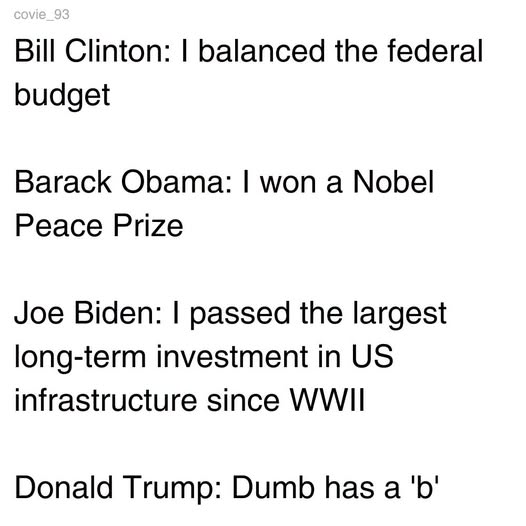
In an era dominated by social media debates, a viral image has gained widespread attention for its humorous and perhaps sobering take on presidential legacies. The image, shared extensively across platforms, lists notable achievements of recent U.S. presidents with a satirical twist: “covie_93 93 Bill Clinton: I balanced the federal budget. Barack Obama: I won a Nobel Peace Prize. Joe Biden: I passed the largest long-term investment in U.S. infrastructure.”
This caption cleverly plays with how presidential accomplishments are perceived and remembered, sparking online discussions about what truly defines a legacy. The message suggests that while accomplishments like balancing the budget or winning awards are notable, long-term investments—like infrastructure—have more tangible, lasting impacts on citizens’ daily lives.
The Power of Presidential Legacies in the Digital Age
Historically, presidents have been celebrated for both tangible achievements and symbolic gestures. Bill Clinton’s administration is often credited with overseeing a booming economy and balancing the federal budget—an accomplishment that Democrats and Republicans alike tout as a major success. However, critics argue that some of these achievements are more complex than they seem, influenced by economic cycles and policy nuances.
Barack Obama’s receipt of the Nobel Peace Prize in 2009 remains one of the most debated awards in recent history. While many saw it as a recognition of diplomatic efforts, others viewed it as premature, given the ongoing conflicts during his early years in office. Still, his tenure’s emphasis on healthcare reform and climate initiatives reshaped national policy debates.
Joe Biden’s recent focus on infrastructure investment, as highlighted in the viral post, marks a significant shift in political priorities—underscoring a focus on long-term economic stability and modernizing America’s aging infrastructure. The Bipartisan Infrastructure Law, signed in 2021, commits around $1.2 trillion toward repairs and upgrades to roads, bridges, transit, and broadband connectivity, with broad support from both sides of the aisle.
Are Long-Term Investments the True Legacy?
This social media meme invites a broader conversation around which achievements stand the test of time. While prize awards and economic balances are often celebrated, initiatives that foster sustainable growth and modernization tend to have more lasting societal impacts.
However, the brevity and humor of the meme also reflect a trend on social platforms to simplify complex political histories into digestible soundbites. It prompts viewers to consider deeper questions: How do we measure presidential success? Is it in immediate wins or enduring progress?
The Digital Age’s Takeaway
As social media continues to shape political discourse, memes like this serve as both humor and commentary. They encapsulate the complex, multifaceted nature of presidential achievements and remind us that history’s judgments are often nuanced. Ultimately, while a Nobel Peace Prize or a balanced budget might make headlines, long-term investments—like infrastructure—are often what leave a lasting mark on the nation’s fabric.
Whether you agree or disagree, this viral post underscores the importance of critical reflection on the legacy of our leaders and the power of social media as a modern forum for public debate.
Where to Learn More
- Biden Signs Historic Infrastructure Bill—What It Means for America – CNN
- The Nobel Peace Prize 2009 – NobelPrize.org
- Bill Clinton’s Presidency: Achievements and Challenges – History.com
- The Impact of Budget Balancing on the Economy – Brookings Institution