
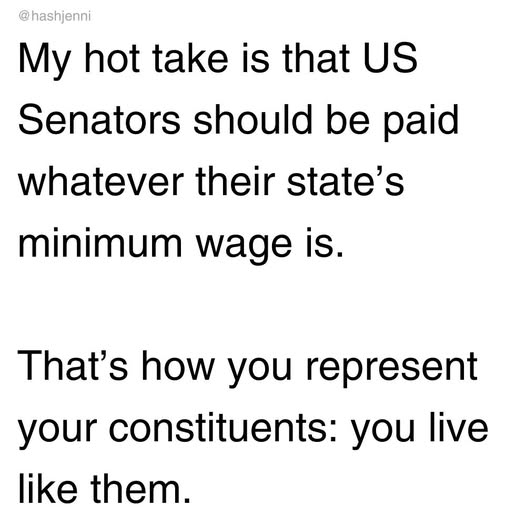
In a viral social media post that has sparked widespread debate, user @hashjenni proposes a radical idea: U.S. Senators should be paid the same as their state’s minimum wage. The reasoning is simple yet provocative—if elected officials truly want to represent their constituents, they should experience life at the same economic level as the people they serve.
The tweet, accompanied by a stark image of text, reads: “My hot take is that US Senators should be paid whatever their state’s minimum wage is. That’s how you represent your constituents: you live like them.” This proposal has gained traction across platforms, resonating with many frustrated Americans who feel disconnected from the realities faced by everyday citizens.
To understand the context, it’s essential to recognize the gaps between the lives of many U.S. lawmakers and the constituents they represent. The median salary for U.S. Senators is over $174,000 per year, a figure that considerably surpasses the minimum wages in most states. For example, in Mississippi, the lowest statewide minimum wage is $7.25 per hour, equating to about $15,000 annually for full-time workers. By comparison, senators earn roughly 11 times that amount.
This stark disparity raises questions about representation and empathy in policymaking. Critics argue that policymakers often lack firsthand experience living on a minimal income, which can influence their stance on issues like healthcare, housing, education, and social services. Advocates of the idea contend that by earning the same as their constituents, legislators would better understand the daily struggles faced by millions, potentially leading to more grounded and compassionate legislation.
However, opponents raise concerns about the practicality and implications of such a move. Some argue that reducing Senators’ salaries to minimum wage levels could hamper their ability to focus fully on public service or dissuade highly capable individuals from pursuing office. Others worry about the logistical challenges and the political resistance such a radical change would encounter.
This viral conversation taps into broader debates about economic inequality and political accountability. It echoes the sentiment that true representation demands empathy—and sometimes, that requires shared experiences. While the idea remains a provocative thought experiment, it has reignited discussions on how to make political leadership more relatable and connected to the populace it serves.
As social media continues to be a powerful platform for activism and ideas, this “hot take” invites voters and politicians alike to ponder what genuine representation looks like—and whether radical changes might be needed to bridge the gap between leaders and constituents.