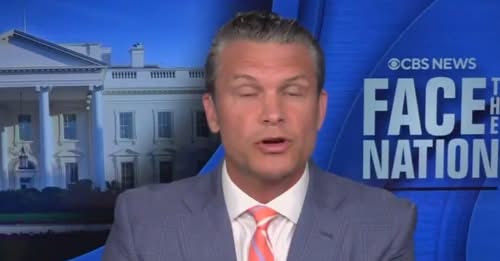
In what quickly became a viral sensation, Secretary of Defense Pete Hegseth’s appearance on CBS’s Face the Nation to defend former President Donald Trump’s military policies toward Iran turned into a heated debate marked by sharp fact-checking and public scrutiny.
Hegseth, stepping into the national spotlight to stoke support for Trump’s aggressive stance on Iran, made a series of claims that were met with mounting skepticism from fact-checkers and analysts. What was intended as a confident defense instead unraveled into a controversial exchange that many observers are calling a “disaster interview.”
The contentious interview began with Hegseth asserting that the Trump administration had successfully contained Iran’s influence in the Middle East without the need for further military escalation. However, when pressed for specifics, he glossed over key facts, notably overlooking the ongoing tensions and recent incidents that suggest Iran remains a volatile player in regional politics.
Perhaps most notably, Hegseth claimed that the Trump era “destroyed Iran’s nuclear program,” a statement contradicted by multiple intelligence reports and experts. Fact-checkers quickly intervened, citing the International Atomic Energy Agency (IAEA) reports that indicate Iran’s nuclear program progressed during Trump’s presidency, despite intense sanctions and covert operations.
The episode took a turn when Hegseth attempted to downplay the consequences of the former administration’s decision to withdraw from the 2015 Iran Nuclear Deal (JCPOA). Critics argue that this move, often justified by claims of “reclaiming strength,” actually set the stage for increased tensions and nearly brought the U.S. to the brink of renewed conflict.
When challenged on these points, Hegseth insisted, “All efforts to engage with Iran were futile, and Trump’s approach was the only path toward peace.” However, analysts and former officials pointed out that diplomatic efforts, though fraught, had shown signs of progress before the withdrawal, and that the subsequent escalation undermined long-term stability.
Social media users and political commentators quickly seized on the interview, with many mocking Hegseth’s attempts to rewrite recent history. One viral meme depicted him trying to “rewrite the Iran playbook,” with fact-check labels highlighting the discrepancies between his claims and verified data.
This incident highlights the ongoing struggle over narrative control surrounding US foreign policy, especially when high-profile officials attempt to defend controversial decisions. Critics argue that presenting misinformation or oversimplified narratives risks misleading the public and undermining diplomatic credibility.
As the debate over US foreign policy heats up again, this interview exemplifies the importance of fact-based journalism and the critical role of media oversight in holding officials accountable. For now, Hegseth’s bold assertions have been met with public skepticism, fueling discussions about transparency and historical accuracy in foreign policy discourse.