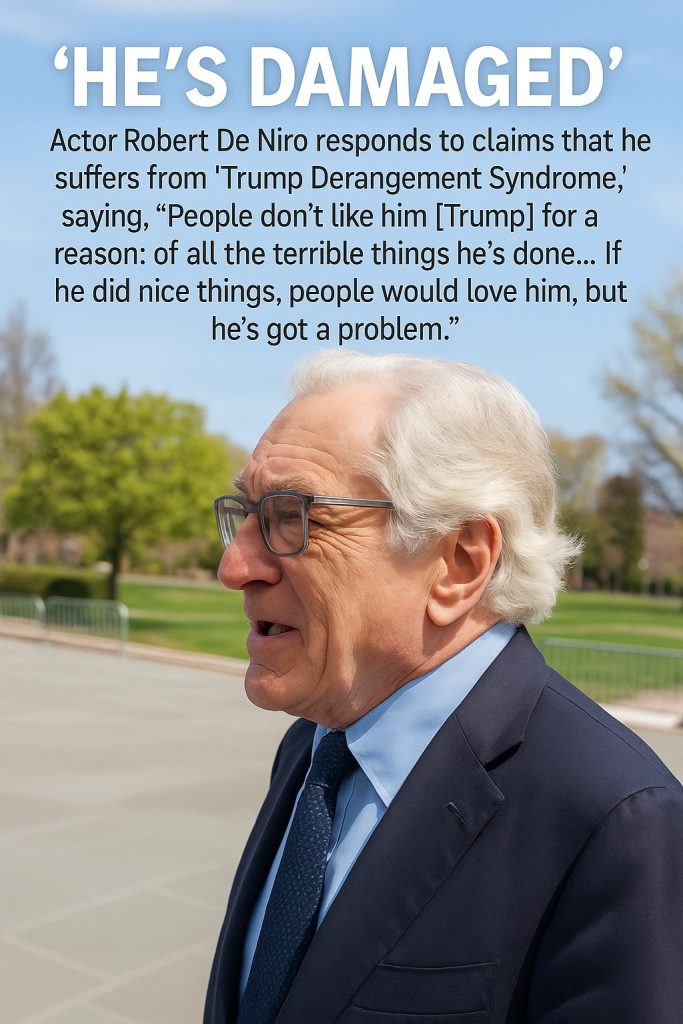
Hollywood legend Robert De Niro has once again weighed in on the polarization surrounding former President Donald Trump, addressing accusations that he suffers from “Trump Derangement Syndrome” with a candid and unfiltered response. The actor, known for his outspoken political views, made headlines after stating that the public’s aversion to Trump is grounded in the former president’s controversial actions, not irrational bias.
During a recent interview, De Niro was confronted with claims that his persistent criticism of Trump stems from an emotional overreaction often dubbed “Trump Derangement Syndrome” — a term popularized by Trump supporters to dismiss opposition and critique. De Niro sharply countered, emphasizing, “People don’t like him [Trump] for a reason: of all the terrible things he’s done… If he did nice things, people would love him, but he’s got a problem.”
His remarks capture the deep divides in American political discourse where “Trump Derangement Syndrome” has become a catchphrase to undermine critics of the former president. De Niro’s comment highlights a perspective shared by many who argue that public scrutiny of Trump is a response to his policies, rhetoric, and actions during his presidency, rather than an irrational or knee-jerk reaction.
Throughout his career, De Niro has not shied away from expressing strong political opinions, famously clashing openly with Trump on platforms big and small. His remarks come at a time when political polarization continues to dominate cultural conversations, fueled by social media and partisan news cycles. De Niro’s comments add fuel to the ongoing debate about how prominent figures engage with political discourse and the nature of dissent in the 21st century.
Critics of Trump often point to his administration’s policies on immigration, climate change, and his handling of the COVID-19 pandemic as key reasons for their disapproval. De Niro’s blunt message underscores what many feel is a legitimate critique grounded in documented events, not merely emotional reactions or media sensationalism. Conversely, Trump supporters argue terms like “Trump Derangement Syndrome” reflect frustration toward those they view as irrationally hostile toward their political icon.
De Niro’s statement, while provocative, also serves to remind audiences that public opinion of political figures is complex and often deeply rooted in tangible actions and consequences. Whether one agrees or disagrees with the actor, his commentary is a potent example of how celebrities continue to play a role in shaping political narratives and conversations.
In the end, De Niro’s words reiterate that beneath the noise of buzzwords and catchphrases lies a substantive debate about a figure who has had an indelible impact on American politics.
Where to Learn More
- Robert De Niro Responds to Trump Supporters with Sharp Rebuttal – The New York Times
- De Niro Dismisses ‘Trump Derangement Syndrome’ Label – NPR
- How Celebrities Shape Political Discourse in the Trump Era – CNN Politics
- The Reality Behind ‘Trump Derangement Syndrome’ – The Washington Post