The recent incident involving the shooting of Kohen Wiley has ignited a furious debate about police accountability and the stark disparities in how law enforcement personnel are disciplined. According to social media posts and community outrage, the officer responsible for shooting the infant was placed on paid administrative leave—highlighting a controversial trend: officers often receive extended paid time off for deadly actions compared to the hardships faced by parents who have children.
The incident unfolded when police responded to a chaotic situation in the community, leading to authorities opening fire. In a tragic turn, an innocent baby, Kohen Wiley, was hit during the exchange. Details surrounding the shooting remain under investigation, but what has shocked many is the subsequent handling of the officer involved. Instead of immediate suspension or termination, the officer was placed on paid administrative leave—an official process that often grants staff weeks or even months of paid time off while investigations proceed.
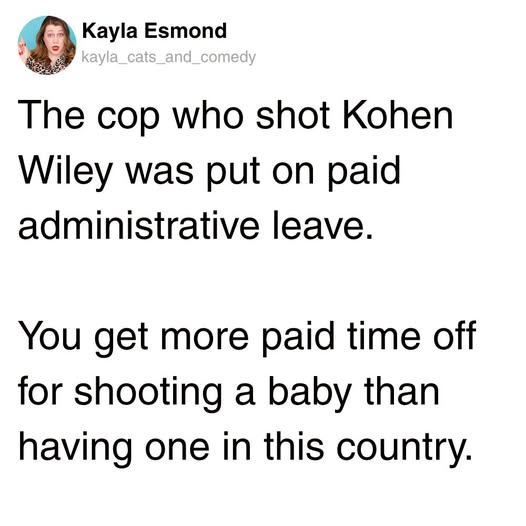
This has sparked widespread outrage, with critics pointing out the perceived double standard: more paid time off for shooting and injuring a child than for being a parent or taking maternity/paternity leave. Social media activists, including users like Kayla Esmond (@kayla_cats_and_comedy), have used platforms to voice their frustrations, emphasizing how such policies perpetuate harmful injustices.
“You get more paid time off for shooting a baby than having one,” one viral post captioned by Esmond succinctly captures community sentiments. The statement underscores a broader societal issue—how law enforcement disciplinary actions can sometimes prioritize protecting officers over justice and accountability for victims, especially vulnerable children.
Advocates argue that police departments need reform that ensures swift accountability rather than protracted paid leaves that appear to insulate officers from consequences. Critics also question the fairness of policies that seem to favor officers in terms of paid leave, regardless of the severity of their actions.
Local community members and activists are calling for transparency, justice for Wiley’s family, and systemic change to prevent future tragedies. Many highlight the importance of independent investigations and alternatives to traditional police responses, such as community-led safety initiatives.
This incident serves as a stark reminder of the ongoing debate surrounding police conduct, disciplinary policies, and societal priorities. As the nation grapples with issues of police reform, cases like this fuel the call for accountability and equitable consequences for all—especially our most vulnerable.