
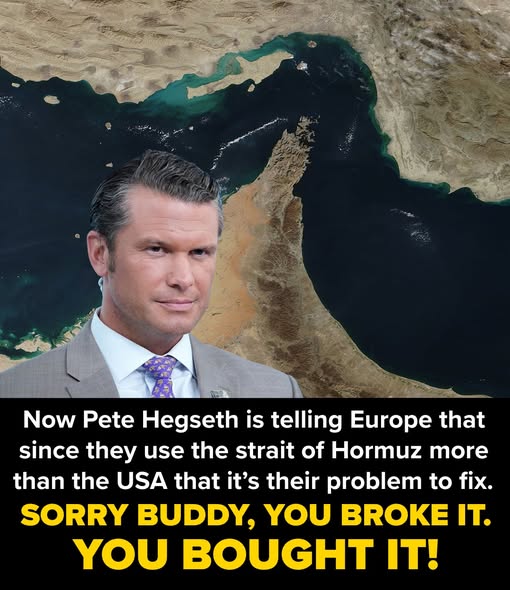
In a recent social media clash that’s capturing widespread attention, Fox News commentator and political figure Pete Hegseth sparked controversy with a pointed message directed at Europe regarding the strategic Strait of Hormuz. Hegseth’s claim that Europe must shoulder the burden of security in the narrow waterway—formerly managed predominantly by the United States—has ignited a heated debate about global responsibilities in navigating geopolitical tensions.
The controversy erupted after an image circulated on social media showing Hegseth asserting, “Now Pete Hegseth is telling Europe that since they use the Strait of Hormuz more than the USA, it’s their problem to fix. SORRY BUDDY, γου BROKE IT. YOU BOUGHT IT.” This provocative statement underscores a perceived shift in U.S. foreign policy expectations, implying that Europe, which relies heavily on oil transit through the Strait, must now take more active steps to ensure regional stability.
The Strait of Hormuz, a critical chokepoint connecting the Persian Gulf to the Arabian Sea, is vital for global oil shipments. Historically, the U.S. has played a dominant role in safeguarding maritime security in the region—militarily patrolling the waters and forging alliances with regional partners. However, recent years have seen calls for more burden-sharing among allies, particularly from policymakers and commentators like Hegseth.
Critics argue that Hegseth’s stance simplifies complex geopolitical dynamics, ignoring the longstanding U.S. military presence and the investment of multiple nations in security arrangements. They contend that Europe’s heavy reliance on Middle Eastern oil makes it equally responsible for contributing to stability but caution against suddenly shifting blame without strategic plans or cooperation.
Supporters, on the other hand, see Hegseth’s remarks as a wake-up call for Europe to ramp up its defense commitments, especially as regional tensions—particularly between Iran and Western powers—intensify. Some analysts suggest that this blurring of responsibility could potentially lead to a shift in U.S. foreign policy, prompting more unilateral actions or increased militarization in the area.
As the debate unfolds across social media and political circles, the core question remains: Who truly bears responsibility for safeguarding one of the world’s most critical maritime routes? Is it Europe, the United States, or a collective international effort? The controversy highlights broader issues around burden-sharing, global security, and the evolving roles of regional powers.
In the meantime, the international community watches closely, understanding that the stability of the Strait of Hormuz impacts global oil prices, economic stability, and geopolitical security. With tensions still high in the region, the discourse initiated by Hegseth adds fuel to ongoing debates about America’s strategic commitments and Europe’s role in maintaining regional peace.
Where to Learn More
- Understanding the Strategic Importance of the Strait of Hormuz – CNN
- Europe’s Role in Middle Eastern Security – Brookings Institution
- U.S.-Europe Relations and Global Security Challenges – Reuters
- The Future of Maritime Security in the Gulf – Center for Strategic & International Studies