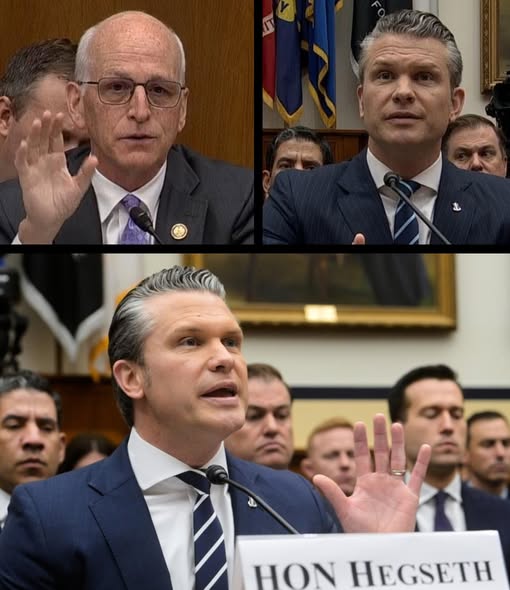
In a dramatic turn of events today, Pete Hegseth, a senior Pentagon official, finally appeared before the House Armed Services Committee amidst mounting controversy over the recent military actions against Iran. His testimony, which was marked by defiance rather than accountability, has ignited a flurry of criticism from lawmakers across party lines.
Hegseth, who has been a prominent proponent of the Trump-era strategy to confront Iran militarily, entered the hearing with a confrontational stance. Rather than addressing the pressing concerns over a $25 billion war launched alleged without explicit congressional approval, he chose to rally against what he called “reckless” and “defeatist” rhetoric from lawmakers. “The biggest challenge we face is the reckless, feckless, and defeatist words of congressional Democrats and some Republicans,” Hegseth proclaimed in his opening remarks, setting a combative tone for the hearing.
The hearing quickly unfolded into a tense exchange, with Rep. Adam Smith delivering a devastating critique that exposed contradictions in Hegseth’s narrative. When asked about the timing of the war, Hegseth claimed Iran’s nuclear facilities had been “completely obliterated” in a 2025 attack. Smith drilled down: if the nuclear threat was eliminated back then, he pressed, what was the justification for launching Operation Epic Fury months later?
Hegseth struggled to provide a coherent answer, only insisting that the war was necessary because Iran’s nuclear program posed an “imminent threat”. Smith was quick to point out the obvious: if Iran’s nuclear sites were neutralized in 2025, then the subsequent conflict had no logical justification. The result, Smith argued, is a conflict that has cost taxpayers $25 billion, depleted U.S. munitions, and destabilized global oil markets—all for an objective that, according to critics, achieved nothing but a stalemate.
Adding to the growing dissatisfaction, even some Republican members voiced cracks in their support. Sen. Thom Tillis expressed serious concerns over Hegseth’s leadership style, particularly criticizing his mass firing of top generals, which has stirred questions about the Pentagon’s strategic stability. Rep. Austin Scott called the dismissals of key military figures “an extreme disservice to the United States Army,” highlighting widespread unease within the national security community.
The tension further escalated when Hegseth snapped at Rep. John Garamendi, demanding, “Who are you cheering for here?” His combative attitude and refusal to answer straightforward questions have led many to question whether Hegseth views congressional oversight as an adversary, rather than an essential check on executive power.
Observers suggest that Hegseth’s performance could harm his credibility and raise concerns about the current direction of U.S. military strategy. His aggressive stance in a forum demanding transparency may reflect deeper discord within the Pentagon concerning independence and accountability. Whether this signals a broader shift in how military officials engage with Congress remains to be seen, but today’s hearing underscored the mounting tensions and the fractured state of U.S. foreign policy in the Middle East.