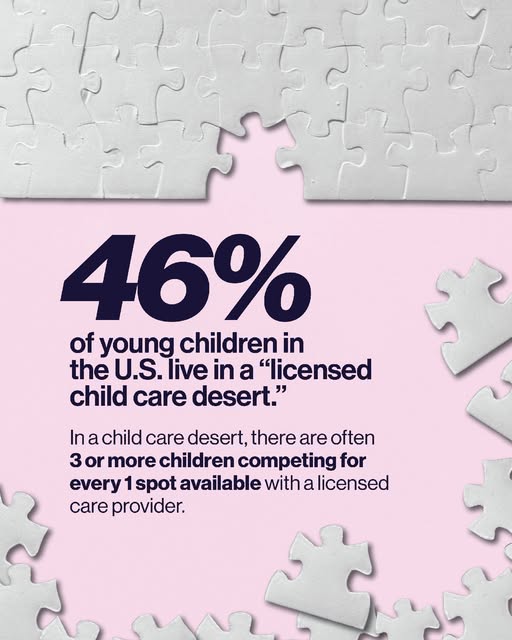
Child care remains one of the most significant challenges facing American families today. While the high costs of quality child care are widely reported, a troubling new statistic reveals that even when families can afford early childhood programs, they often struggle to find available spots. Recent data indicates that 46% of young children in the United States live in “licensed child care deserts”, communities where there are often three or more children competing for each licensed care provider.
This phenomenon profoundly impacts working parents who rely on reliable child care to maintain employment and support their families. When the supply of licensed providers fails to meet demand, parents face difficult choices — from lengthy waitlists and long commutes to abrupt adjustments in work schedules or even reducing hours. In some cases, families are forced to leave their jobs altogether simply because they can’t secure child care placement.
Child care deserts are typically concentrated in rural areas but are also prevalent in urban centers. A recent graphic circulating on social media emphasizes the dramatic scope of this issue: with a pink background and puzzle pieces symbolizing community interconnectedness, the visual highlights that nearly half of American children are in environments where access to quality, licensed care is scarce or nonexistent. This shortage not only hampers early childhood development but also disproportionately affects low-income families, exacerbating existing inequalities.
Experts warn that these shortages threaten to undermine long-term economic growth. “Without access to affordable, high-quality child care, parents are less able to participate fully in the workforce, which impacts both individual families and the economy as a whole,” says Dr. Lisa Johnson, a child development specialist. She adds that addressing the problem requires coordinated policy efforts, including increased funding for child care programs, incentives for providers, and investments in rural and underserved communities.
Several states and local governments are beginning to recognize the crisis by implementing innovative solutions. These include expanding public child care facilities, offering grants and subsidies to providers to increase capacity, and exploring alternative care models such as cooperative care arrangements. Still, experts agree that much more work must be done to close the child care gap and ensure that children across the country have access to safe, constructive environments while their parents work.
For families navigating this landscape, community resources and advocacy groups can be valuable allies. If you suspect your community may be a child care desert or want to learn about local options, it’s crucial to stay informed and involved in policymaking efforts. As the data makes clear, accessible child care is a cornerstone of a healthy, equitable society — and one that requires urgent attention.
Where to Learn More
- Child Care Deserts: What They Are and How They Impact Families – Child Care Aware of America
- Understanding Child Care Deserts – National Association of Child Care Resource & Referral Agencies
- The Growing Crisis of Child Care Deserts in America – Urban Institute
- State Strategies to Address Child Care Shortages – National Conference of State Legislatures