
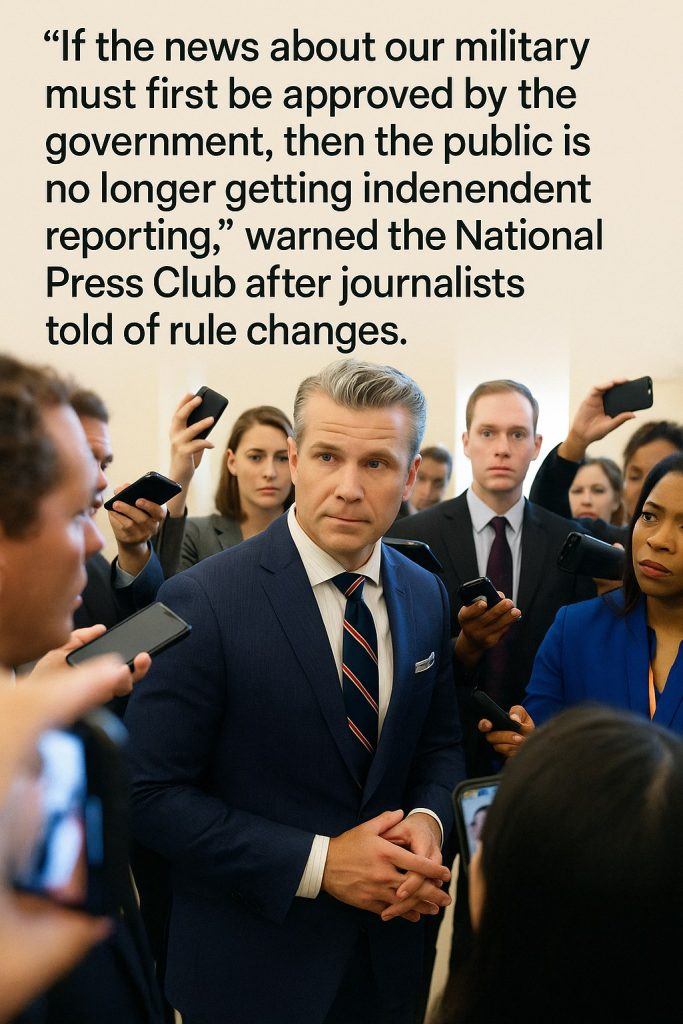
The National Press Club has raised serious concerns over recent changes to the way military news is reported, suggesting that a government approval process threatens the independence of journalism. In a statement made by its leadership, the organization highlighted the implications of new rules that require journalists to seek pre-approval before reporting on military matters, describing it as a worrisome shift away from transparent, unbiased reporting.
“If the news about our military must first be approved by the government, then the public is no longer getting independent reporting,” the National Press Club warned, amplifying fears among journalists and advocates of press freedom. This development has ignited discussions on social media, where many fear that it could lead to a manipulated narrative surrounding military actions and policies, hampering democratic accountability.
The change reportedly stems from an internal directive within the Department of Defense aimed at managing how information regarding military activities is disseminated. Journalists who have covered the military extensively expressed their outrage, indicating that this kind of censorship undermines their credibility and hinders their duty to inform the public.
“Our role as journalists is to act as watchdogs of government, especially in matters related to national security,” a seasoned military correspondent stated. “If we are not free to report on the military without bureaucratic hurdles, we risk becoming mouthpieces for the very entities we are meant to scrutinize.”
The timing of these rule changes has drawn particular scrutiny, with some suggesting that it may be an attempt to control narratives in the wake of rising public interest and scrutiny of military operations. Recent conflicts, coupled with domestic unrest, have elevated awareness about the use of military power and state accountability.
Advocates for a free press are rallying around this issue, urging media organizations to resist compliance with these new regulations. Digital platforms have seen a surge of hashtags like #FreePress and #MilitaryTransparency aimed at creating awareness and encouraging public discourse on the importance of an independent press.
This controversy also aligns with broader conversations surrounding freedom of speech and press freedoms in the United States. Many journalists are now calling for legislative measures to prevent the imposition of such regulations without public oversight and debate.
The National Press Club is not alone in its concerns; various journalistic organizations, including the Committee to Protect Journalists (CPJ) and the Society of Professional Journalists (SPJ), have echoed the sentiment that without a free press, democracy itself is at risk. Their collective voice aims to remind the public of the vital role independent reporting plays in a functioning democracy.
As discontent grows over the evolving landscape of military reporting, the National Press Club is calling on members of the press, public policy experts, and citizens to engage in dialogue about the necessary protections for journalistic independence. “It is paramount for our democracy that military actions are reported without censorship,” they concluded, emphasizing the significance of press freedom in holding power accountable.
Where to Learn More
- National Press Club – National Press Club
- Committee to Protect Journalists – CPJ
- Society of Professional Journalists – SPJ
- Analyzing the Relationships between Media and Government – NPR
- Recurrent Issues in Military Reporting – Reuters