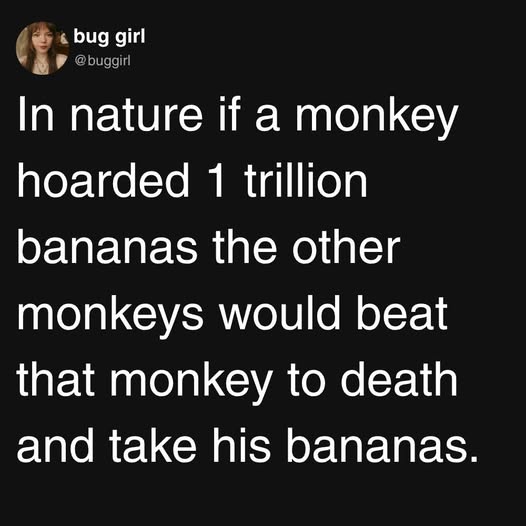
The viral social media post comparing monkey behavior to human greed has sparked widespread conversation about nature, possession, and societal instincts. The post, featuring the provocative statement, “In nature, if a monkey hoarded 1 trillion bananas, the other monkeys would beat that monkey to death and take his bananas,” draws attention to the raw, often aggressive, competitive nature observed in primate communities—and by extension, in human society.
This stark analogy prompts us to reconsider how resource hoarding influences social dynamics. In the natural world, many animals—including monkeys—live within hierarchies that quickly shift based on resource availability. The post suggests that no matter how much a monkey accumulates, the instinctual drive of other monkeys—symbolizing rivals—would lead to confrontation and redistribution. While exaggerated for effect, the sentiment echoes deeply rooted evolutionary behaviors: competition, territoriality, and social dominance.
Experts have long studied primate behavior to understand the roots of human social structures. Dr. Jane Goodall, renowned primatologist, once observed that chimpanzees—closely related to monkeys—often engage in violent competitions over food and status. Her studies highlight that resource scarcity or accumulation often fuels aggression and social conflict in animal communities, and these behaviors trace back to our evolutionary ancestors.
In human society, the analogy becomes even more compelling. The social media post seems to underscore a fundamental truth: regardless of the size of one’s possessions, societal pressures, greed, and competition tend to override notions of fairness or security. The idea of a monkey hoarding a trillion bananas symbolizes limitless greed, while the reaction of others seeking to seize it underscores the perpetual struggle for resources in human life, from wealth to power.
Some critics argue that the exaggeration diminishes the complexity of human morality but acknowledge it as a compelling metaphor for the destructive tendencies linked to greed and possessiveness. Meanwhile, others see it as a reminder of innate survival instincts—often viewed as outdated in modern, more compassionate societies—that continue to influence individual and collective behaviors.
Regardless of interpretation, the post invites us to reflect on our shared biological origins and the societal norms that attempt to regulate these primal drives. It raises an intriguing question: If humans were subjected to the same evolutionary pressures as monkeys, how different would our world look? Would we, too, resort to aggression and confrontation for prominence and resources?
Ultimately, this social media sensation highlights how deeply intertwined our behavior is with our biological roots and warns us about the dangers of unchecked greed and rivalry. Whether in the jungle or in our cities, the urge to secure resources often comes with a hefty dose of human—or primate—volatility.
Where to Learn More
- Primates and Their Social Structures – National Geographic
- Jane Goodall Institute on Primatology – Jane Goodall Foundation
- Competition and Cooperation in Evolution – Psychology Today
- Monkey – Encyclopaedia Britannica