
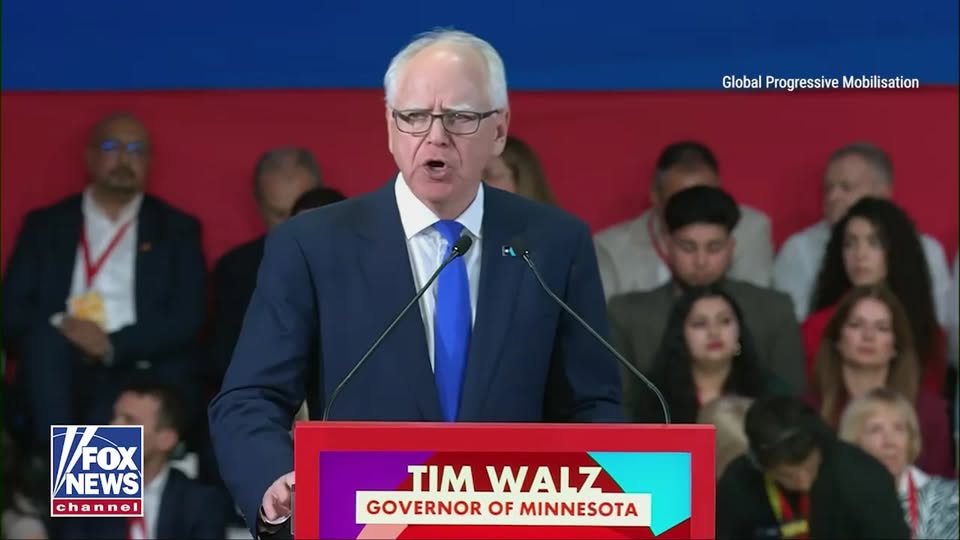
In a fiery speech that has quickly gone viral on social media, Minnesota Governor Tim Walz delivered a stark critique of the current US administration’s foreign policy, describing the President as a “feeble-minded, trigger-happy leader” who led the nation into a misguided war. Walz’s comments come amidst growing public and political debate over the motivations and consequences of recent military interventions.
“We’ve got a feeble-minded, trigger-happy president who plunged us into a war where no threat was present, with no clear objectives and no exit plan,” Walz said during a recent public appearance. His words echoed across social media platforms, sparking widespread discussion and polarized reactions among activists, politicians, and the general public alike.
The governor’s condemnation is notable because it openly challenges the narrative of mainstream political leaders and raises concerns about executive decision-making at the highest levels. Walz’s critique touches on a recurring theme: the perceived lack of transparency and strategic planning behind the United States’ recent military actions. Critics argue that such interventions often lack clear objectives, leading to prolonged conflicts with devastating humanitarian consequences.
More controversially, Walz explicitly linked the current leadership’s approach to “fascism,” further intensifying the debate over rising authoritarian tendencies within American politics. “We need to call that what it is. That,” he asserted, drawing parallels between the current policy environment and historical instances of authoritarian regimes that suppress dissent and concentrate power.
The statement has sparked a mixture of praise and outrage. Supporters see Walz’s words as a courageous stand for accountability and transparency, emphasizing the importance of scrutinizing military and foreign policy decisions. Conversely, critics accuse him of hyperbole and undermining national security efforts, arguing that the President’s decisions were necessary responses to international threats.
This commentary comes at a time of heightened political tension in the United States, with debates over constitutional rights, executive authority, and the role of the military often spilling into public discourse. The rhetoric used by Walz underscores the deepening divisions over America’s posture on the world stage and questions of democratic accountability.
As the conversation continues to evolve, many observers are watching closely to see whether these critiques will influence policy decisions or provoke broader discussions about the nature of leadership and democracy in America. With wars and international conflicts still at the forefront, the intensity of these debates highlights the ongoing struggle to define what America’s role should be moving forward.