
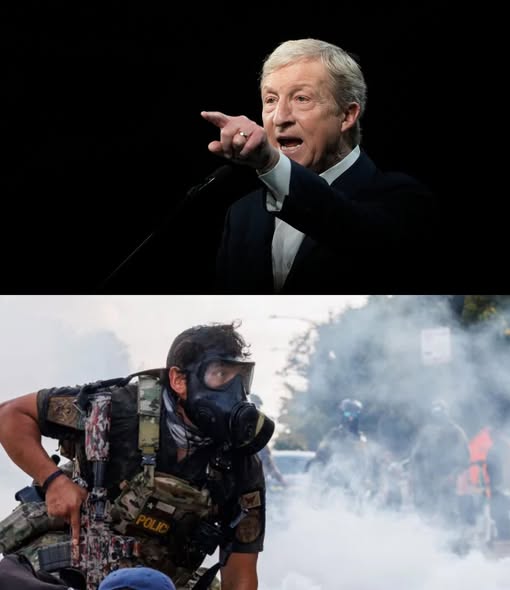
In a breakthrough moment that signals a potential shift in accountability for federal immigration enforcement, Minnesota’s Hennepin County has filed felony charges against an ICE agent involved in a dramatic and dangerous incident. Gregory Donnell Morgan Jr. faces two counts of second-degree assault with a dangerous weapon after pointing a loaded gun at two civilians during a routine traffic stop—an unprecedented move that could set a nationwide precedent.
This development follows the recent political surge inspired by Tom Steyer’s bold proposal to empower California’s attorney general to criminally prosecute ICE agents, accusing the agency of transforming into a “criminal enterprise” under the Trump administration. Steyer’s plan—announced earlier this week—aims to establish state-level authority to hold federal immigration agents accountable for illegal actions, a move seen as radical and controversial by critics but increasingly supported by advocates for accountability.
Today’s charges against Morgan mark a historic first: it is believed to be the first time a federal immigration agent has faced criminal prosecution for misconduct during the controversial Operation Metro Surge in Minneapolis. Hennepin County Attorney Mary Moriarty announced that Morgan was driving an unmarked SUV on the shoulder of a highway after his shift when a motorist in a white Cadillac moved to block him—a typical Minnesota gesture of local civility. In a reckless move, Morgan then pulled alongside the vehicle, rolled down his window, and pointed his loaded firearm at the heads of the driver and passenger.
Astonishingly, both victims contacted 911, unaware that the man threatening them was a federal agent, not a local law enforcement officer. Investigators uncovered that Morgan admitted to a Minnesota State Trooper that he drew his weapon only after the vehicle had returned to its legal lane—an assertion captured by body camera footage. Moriarty emphasized that this case is uniquely well-documented. “This is the only Metro Surge incident where prosecutors have the agent’s own statement, video evidence, and witness testimony,” she said.
Contrast this with the federal government’s longstanding refusal to prosecute misconduct within ICE, often citing “total immunity.” Yet, Moriarty’s actions challenge that notion, demonstrating that state authorities can step in and seek justice. Unlike many other cases involving the deaths of civilians such as Renee Good and Alex Pretti—cases that have been hindered or blocked by federal agencies—this case moved quickly through the local justice system.
Steyer’s bold plan emphasizes building on this model: creating specialized investigative units, granting state-level prosecution powers, and holding leadership accountable—ensuring that individual agents and their superiors can be prosecuted for misconduct. “Driving while pointing a gun at civilians,” Moriarty noted, “could have led to disaster. Accountability is within reach.”
This incident underpins a broader debate about federal immunity and accountability. Legal scholars have repeatedly challenged the Trump administration’s claims of immunity for ICE agents, arguing that their conduct must be held to account under state law. Today’s move by Minnesota signals that such enforcement is not only possible but may become more common if similar laws supporting state prosecution are adopted elsewhere.
As Steyer’s campaign continues to push for reforms, this developing case demonstrates that, at least in some jurisdictions, meaningful action is already underway—proof that holding ICE agents accountable is no longer just a political slogan, but a tangible reality.