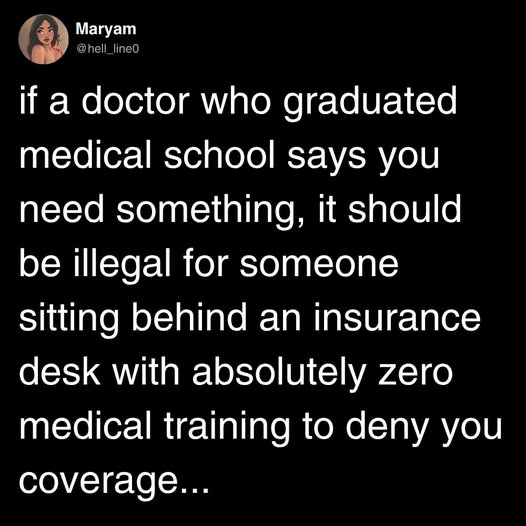
In a viral social media post garnered attention across multiple platforms, a striking claim has sparked widespread debate about healthcare authority and patient rights. The message, originally shared by user Maryam (@hell_line0_line0), asserts, “If a doctor who graduated medical school says you need something, it should be illegal for someone sitting behind an insurance desk.”
The statement strikes at the heart of ongoing tensions between healthcare professionals, insurance companies, and patients. At its core, it questions the legitimacy of insurance desk representatives making decisions that directly impact a patient’s access to necessary medical care—a practice that often causes frustration among those navigating complex healthcare systems.
So where does this sentiment come from? Many patients and advocacy groups argue that insurance company policies can sometimes delay or deny essential treatments, procedures, or medications, regardless of the medical consensus. When decisions about coverage are made behind closed doors, often without direct input from healthcare professionals, it can lead to situations where a patient’s health is compromised.
“Medical advice should come from licensed professionals who have dedicated years to understanding these issues,” says Dr. Emily Saunders, a practicing physician with over 15 years of experience. “It’s troubling when non-medical personnel—particularly those whose primary goal is cost containment—are given authority to override clinical judgment.”
The social media post has ignited debates on multiple fronts:
- Patient autonomy: Should patients have the final say based on their doctor’s advice, or should insurance companies have the power to limit coverage?
- Ethics in healthcare: Is it ethical for insurance companies to deny coverage based on cost concerns rather than medical necessity?
- Legal frameworks: What legal protections exist for patients facing coverage denials, and do these need to be strengthened?
Some experts point out that insurance companies employ prior authorization policies—a process designed to ensure medical procedures are medically necessary—to control costs. However, critics argue that this process often causes unnecessary delays and emotional distress for patients awaiting critical treatment. Advocates believe that decisions about medical necessity should be made solely by licensed healthcare professionals, not dictated by insurance policies or financial considerations.
This controversy underscores a larger debate about the balance of power in healthcare—how to ensure patients receive necessary care without compromising the financial viability of insurance providers or healthcare systems. Many are calling for reform, proposing increased transparency, streamlined approval processes, and stronger regulations to protect patient rights.
While social media posts like Maryam’s resonate with many, policymakers and healthcare leaders are grappling with finding solutions that honor both medical expertise and financial sustainability. Until then, the collective voice calling for physician-led decision-making continues to grow louder, shedding light on the fundamental question: should healthcare decisions be driven by a doctor’s advice or insurance policies?
Where to Learn More
- Healthcare Policy and Insurance Decisions: What Patients Need to Know – Health Affairs
- The Role of Physicians in Insurance Coverage Decisions – American Medical Association
- Insurance Denials and Appeals: What Patients Should Know – Kaiser Family Foundation
- How Insurance Companies Deny Coverage and What You Can Do About It – Healthline