
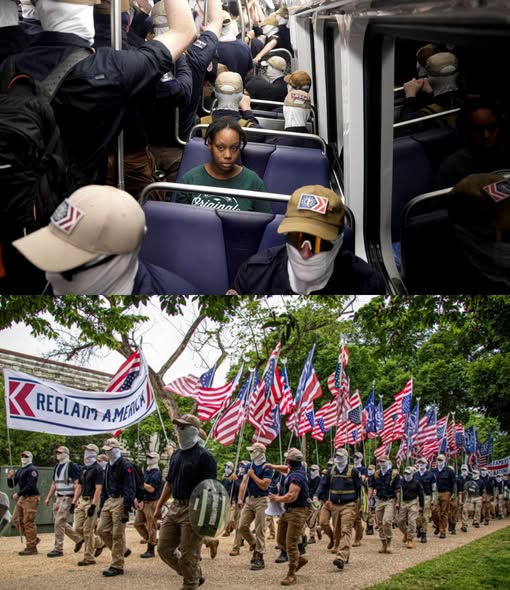
On the morning of America’s 250th birthday, a disturbing display unfolded on the steps of Capitol Hill. A few hundred men, clad in khakis and masks, marching in unison with Confederate flags waving beside upside-down American banners. With drums pounding and chants echoing through the historic grounds, these individuals identified as members of the neo-Nazi group Patriot Front took to the streets, explicitly calling for ethnic cleansing and anti-immigrant policies.
Every face was meticulously concealed behind masks, a calculated move to hide identities while projecting a message of menace. The protesters, numbering approximately 400 by their own count, conducted their march camouflage-style, a form of provocative “costume theater” designed for spectacle and media attention. Their history reveals a pattern of tactical marches: showing up unannounced, inflating their crowd size, and dissolving into public transit and rental vehicles before authorities can respond effectively.
Patriot Front traces its origins directly to Charlottesville, emerging from the disintegration of a broader neo-Nazi movement. It was founded by Thomas Rousseau, then a teenager, after the violent aftermath of the Charlottesville protests in 2017, where white supremacist violence resulted in the death of Heather Heyer. Known for its provocative marches, Patriot Front has been involved in various acts of intimidation and vandalism, including a notorious attempt to deface Arthur Ashe’s mural — an incident they ultimately flopped at in court due to cowardice and fear of accountability.
Yet, what stands out most on this particular day is the response—or notable lack thereof—from the U.S. government. Despite the clear demonstration of extremism — chanting about white supremacy, waving racist symbols, and calling for racial exclusion — authorities responded with a startlingly dismissive attitude. The official official statement? “First Amendment activities.”
In one stark contrast, a New York Times reporter observed Capitol Police swiftly detaining an Air Force major for calling for President Trump’s impeachment, minutes after justifying the masked marchers’ presence as protected speech. Meanwhile, the masked group was allowed to march freely, then quickly disperse, fading into the bustling city before crowds gathered for celebrations later that evening.
This pattern of unchecked extremism sends a troubling message. While law enforcement swiftly responded to a single person advocating for impeachment—an individual exercising basic free speech—the same authorities tolerated the presence of masked men openly calling for racial violence and exclusion, offering no arrests or intervention. Their march was, in effect, a symbolic defiance of Americanvalues, yet they were let go with minimal interference, reinforcing the disturbing fact that hate groups are emboldened when ignored.
By sunset, the National Mall was filled with the country’s true fabric — diverse Americans coming together to celebrate their independence. The fireworks lit up the night sky as the patriotic display stood in stark contrast to the masked marchers’ hollow demonstration. Ironically, these men who claimed to want to “reclaim” their nation could not even show their faces in the land they say they love.
In the context of a nation grappling with rising hate and extremism, this incident raises pressing questions about the limits of free speech and the government’s role in countering domestic terrorism. While patriotic Americans celebrated their independence, masked extremists—the symbols of division—fled into the shadows, their presence a stark reminder of the ongoing struggle within America’s democracy.