
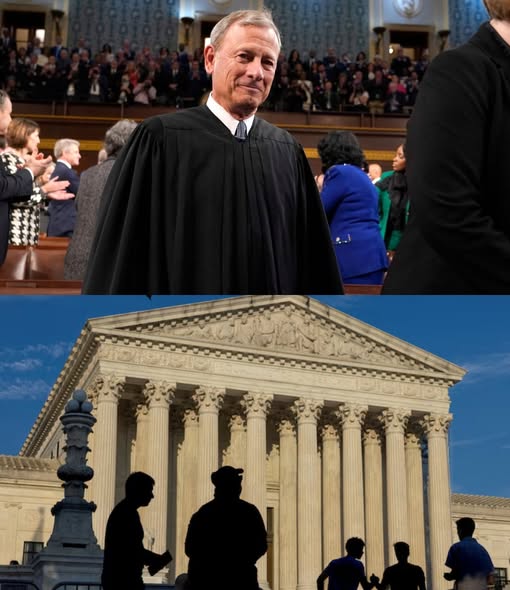
In a stunning revelation that shakes the foundations of American judicial transparency, The New York Times has published leaked internal memos demonstrating how the Supreme Court has secretly been making major policy decisions without the usual public scrutiny. Known as the “shadow docket,” this behind-the-scenes process allows the Court to issue rulings — often of enormous political and societal consequence — without written opinions, verbal arguments, or transparent reasoning.
The leak uncovers a pivotal moment in 2016, when Chief Justice John Roberts personally expedited an emergency request from West Virginia to block the Obama administration’s Clean Power Plan. Without oral arguments, full briefing, or a written explanation, the Court issued an unsigned order that effectively halted one of the most significant climate regulations in U.S. history. This ruling, initially presented as an emergency measure, set a troubling precedent. What was supposed to be an exception to the norm has since become the rule — a preferred method for the Court to decide high-stakes issues quietly and swiftly.
Over the past decade, the shadow docket has evolved dramatically from an emergency tool used primarily in death row cases to a powerful weapon that reshapes policy on a broad scale. The Court now routinely issues major rulings through this opaque channel: unsigned, unexplained, and unchallengeable, with no dissenting opinions or public justification. No detailed records are kept, and the public remains largely in the dark about the Court’s true reasoning, leading to profound questions about accountability.
The influence of the shadow docket has intensified during the Trump administration’s second term, with rulings that dramatically impacted millions of Americans. Through this process, the Court allowed the firing of federal workers amid ongoing lawsuits, kept the ban on transgender military service in place while litigation continued, and handed victories to the Trump administration — all without elaborating on legal rationale or giving the public a chance to scrutinize the decisions.
Justice Ketanji Brown Jackson recently sounded the alarm during a speech at Yale Law School, highlighting the troubling evolution. Reflecting on her clerkship days in 1999, she noted that the shadow docket was once reserved “almost exclusively for death row inmates.” Today, she warned, it’s used to decide the fates of millions, bypassing traditional legal procedures and transparency.
“Today, the court routinely opts to enter the fray,” Jackson stated, “and it fails to acknowledge the harms that follow when the Supreme Court of the United States consistently and casually divests the lower courts of their equitable authority.”
This covert approach isn’t just a deviation from tradition; it’s a strategic move that sidelines accountability and public oversight. With no written opinions, there are no detailed records or explanations to hold the Court accountable. This lack of transparency allows the conservative majority to push through policy shifts without providing clarity or public debate—effectively doing whatever it deems necessary behind closed doors.
Critics argue that the shadow docket undermines the very foundations of judicial transparency and could erode trust in the Supreme Court itself. As the Court continues to wield this secretive power, many are calling for reforms that ensure decisions meet the standards of openness and accountability the American legal system strives to uphold.