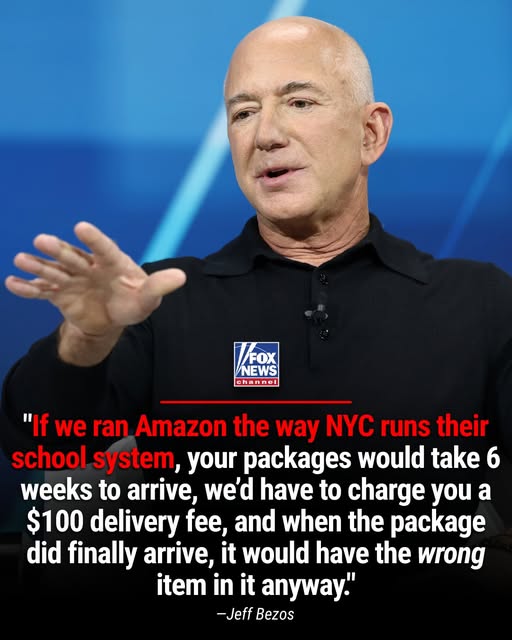
In a bold social media post that quickly went viral, billionaire Jeff Bezos took aim at the wastefulness and inefficiency of New York City’s government, particularly criticizing its education system. Comparing the city’s management style to that of Amazon, Bezos jokingly, yet sharply, warned of what might happen if he ran the retail giant with the same disorganization and excess he perceives in NYC governance.
Bezos’s comments, shared widely on social media, read: “If we ran Amazon the way NYC runs their school system, packages would take 6 weeks to arrive, we would charge you a $100 delivery fee & when the package did finally arrive, it would have the wrong item in it.” This humorous yet pointed critique highlights what many see as the outdated and inefficient systems still prevalent in large bureaucratic entities, especially within public school districts.
New York City’s public school system, with a budget of approximately $44.6 billion for the 2025-26 school year, continues to face criticism for its performance and management. Despite this massive investment, students in NYC consistently underperform compared to national averages, according to reports from the National Assessment of Educational Progress (NAEP). Many educators and taxpayers question whether the funds are being allocated effectively or if systemic waste persists.
Bezos’s comment taps into a broader debate about government efficiency versus private enterprise. Critics of large public agencies argue that bureaucratic red tape, misallocated resources, and political considerations often hinder progress and service quality. Bezos’s hypothetical scenario—packages delayed, exorbitant fees, and wrong items—serves as a satirical mirror to frustrations held by many taxpayers and parents about the perceived mismanagement of city schools.
While Bezos’s remarks are clearly tongue-in-cheek, they raise serious questions about how public institutions are run and the potential benefits of introducing reforms or privatization models. Supporters of private management argue that competition and innovation can lead to better outcomes, citing Amazon’s efficiency and customer service as benchmarks.
Meanwhile, critics contend that the comparison oversimplifies the complexities of public education and the challenges faced by government agencies. Nonetheless, the viral post has ignited a fresh discussion about spending priorities, accountability, and the best ways to ensure quality education for all students.
As New Yorkers watch their city grapple with these issues, Bezos’s humorous critique has added a new voice to the debate—one that might push policymakers to reevaluate their approaches and focus on delivering better service at less cost.