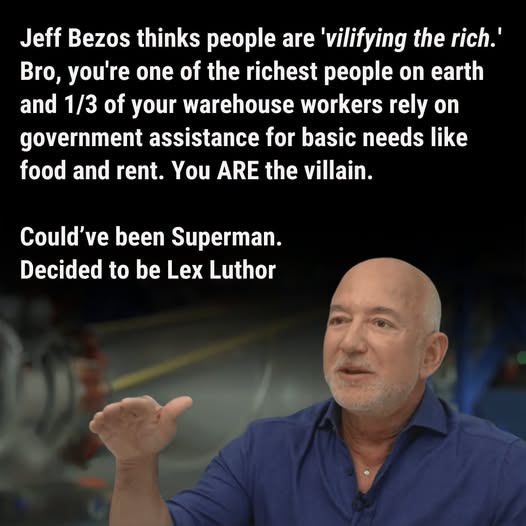
In a recent social media post gaining widespread attention, billionaire Amazon founder Jeff Bezos suggested that the public is unfairly “vilifying the rich” amidst growing concerns over corporate labor practices and economic inequality.
The comment, paired with an image depicting Superman and bold text reading “Jeff Bezos thinks people are ‘vilifying the rich’,” has sparked a heated debate across social platforms. Critics argue that considering Bezos’s immense wealth and the conditions faced by many of his workers, his claims seem out of touch with the realities of millions struggling to make ends meet.
Bezos’s wealth has long been under scrutiny—his net worth, soaring past $150 billion at times, makes him one of the wealthiest individuals in modern history. Yet, his recent comments highlight a common narrative among the ultra-rich: that they are victimized or unfairly targeted for their wealth. In his statement, Bezos implied that society’s focus on income inequality and labor rights might be overstated or misdirected.
However, data paints a contrasting picture. Reports indicate that approximately one-third of warehouse workers at Amazon rely on government assistance programs such as food stamps and Medicaid to get by, raising questions about the sustainability of such low wages and demanding working conditions. Critics argue that this reliance on social safety nets underscores systemic issues within Amazon’s labor practices and broader corporate responsibility.
Labor advocates have pointed out that while Bezos and other billionaires celebrate their wealth and philanthropic efforts, the day-to-day reality for many Amazon warehouse employees involves grueling hours, high-pressure environments, and inadequate health and safety protections. Several investigations have uncovered allegations of exploitative practices, with reports of employees working through injuries and being penalized for taking bathroom breaks.
Amazon, known for its rapid growth and market dominance, often dismisses these claims, asserting that they provide competitive wages and benefits. Yet, critics argue that the business model prioritizes efficiency over employee well-being, creating a paradox where the wealth generated by such companies may come at the expense of those at the bottom of the ladder.
This controversy surfaces amid a broader societal debate about income inequality, corporate responsibility, and the limits of wealth accumulation. While Bezos suggests that the public is unfairly targeting the rich, others contend that the focus should be on fixing the systemic issues that allow such disparities to persist.
As discussions continue, this viral social media post underscores the growing disconnect between perceptions of wealth and the lived realities of everyday workers, prompting a serious reflection on the true cost of economic prosperity in the digital age.
Where to Learn More
- Inside Amazon’s Warehouse Conditions: The Hidden Struggles of a Corporate Goliath – The New York Times
- Amazon Workers Rely on Public Assistance: A Closer Look – ProPublica
- Jeff Bezos and the Narrative of Wealth and Fairness – The Guardian
- Analyzing Amazon’s Labor Practices and Public Response – CNN
- The Wealthiest and Their Critics: A Global Perspective – BBC News