
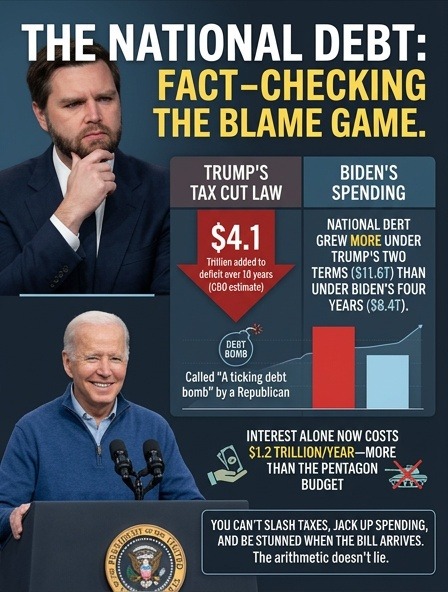
In a recent appearance on Newsmax, Ohio Senator JD Vance took a bold shot at President Joe Biden, claiming the Biden administration inherited a “$40 trillion national debt bomb” and asserting that Treasury has a “very discreet plan” to grow our way out of it. But there’s a sharp contrast between Vance’s characterization and the reality of what has driven those staggering numbers.
The national debt surged past $40 trillion on Wednesday, a milestone that visibly alarms many Americans. Vance pointed fingers at Biden, asserting that the current debt is primarily Biden’s fault. However, a closer look at the numbers paints a different picture—one that reveals just how much of this debt was accumulated prior to Biden’s presidency.
Under Biden’s four years in office, the debt increased by about $8.4 trillion. While significant, that figure is eclipsed by the $11.6 trillion added during Trump’s two terms. In fact, nearly one-third of the entire $40 trillion debt was accumulated before Biden took office, during Trump’s administration, including a hefty $3.8 trillion increase just in the last 18 months of the Trump era.
The largest contributor to this recent spike is the “One Big Beautiful Bill,” the tax-cut law signed by Trump last summer. According to the Congressional Budget Office, a nonpartisan agency relied upon by both parties, the tax package alone is projected to add $3.4 trillion to the deficit over ten years—rising to $4.1 trillion when interest costs are included. That’s a pretty clear demonstration: slashing taxes while increasing spending doesn’t come with a free pass or a surprise.
Interestingly, the irony of blame runs deep. Republican Congressman Thomas Massie from Kentucky publicly called Trump’s tax cuts “a debt bomb ticking” and voted against the bill. Recently, he reminded colleagues: if you voted for the bill, don’t pretend to be surprised that the debt has hit $40 trillion. According to Massie, it was obvious to anyone with a “room temperature IQ” and is a perfect example of how political narratives often twist the facts.
And here’s the critical kicker: the interest on the current debt now exceeds the entire Pentagon budget. This year, servicing the debt has cost nearly $1.2 trillion—more than what’s spent on Medicare and closing in on America’s defense spending. The debt is not just a future problem; it’s a present-day crisis fueled by decisions both past and present.
Vance’s assertion that Treasury has a “discreet plan” to grow out of the debt conveniently skips over the basic arithmetic behind it. The spending and tax policies behind these numbers remain evident. The real trick is that the people responsible for the mess often point fingers elsewhere, with little accountability or acknowledgment of their own role.
As the debt clock continues to tick upward, the message is clear: this isn’t a partisan issue—it’s an arithmetic issue. The question is whether policymakers and citizens alike will confront the facts or turn a blind eye while the bill keeps mounting.
Where to Learn More
- The CBO’s Cost Estimate of the Tax Cuts and Jobs Act – Congressional Budget Office
- Why the U.S. National Debt Matters – The National Interest
- How America’s Debt Has Grown Over the Years – Washington Post
- Debt Talks: Who’s Responsible for America’s Growing Debt? – CNN