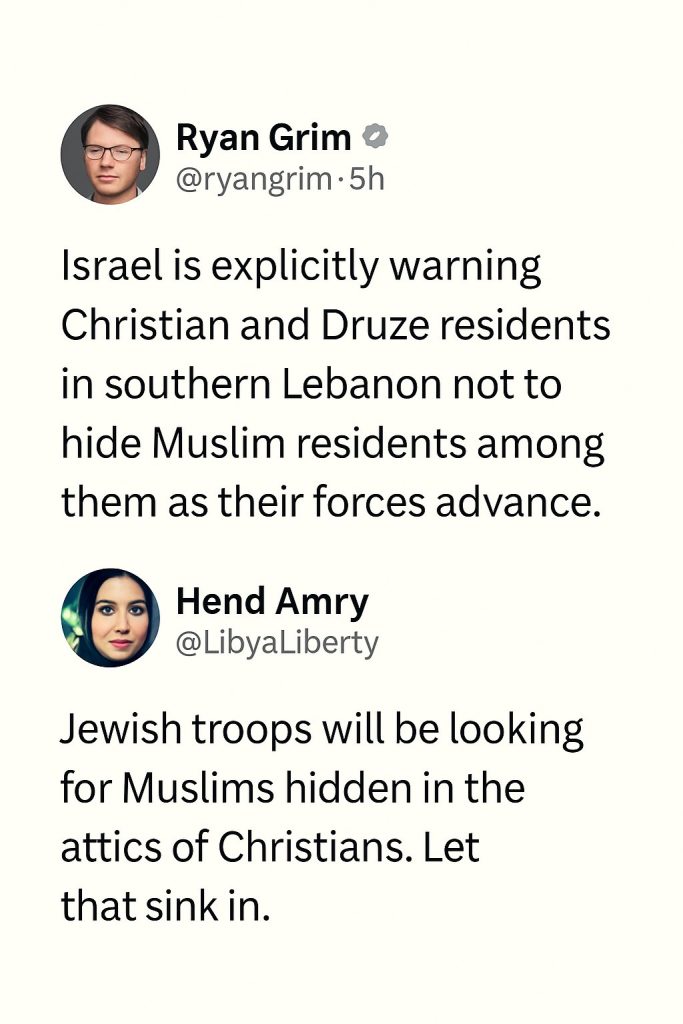
As tensions escalate in the Middle East, Israel has reportedly issued a direct warning to Christian and Druze residents in southern Lebanon. According to a recent social media report by journalist Ryan Grim, Israel is explicitly cautioning these communities against harboring Muslim residents as Israeli forces advance in the region.
This message comes amid rising conflict dynamics that have drawn global attention, with concerns mounting over the safety of civilian populations caught in the crossfire. Southern Lebanon, home to a diverse mosaic of ethnic and religious groups, has historically been a flashpoint for conflict involving various militant factions, including Hezbollah, which is predominantly Shia Muslim.
The Context of the Warning
Israel’s advance into southern Lebanon is rooted in long-standing security concerns, with its military operations often framed as efforts to counteract militant threats near its northern border. The explicit warning to Christian and Druze communities not to shelter Muslims could indicate heightened Israeli efforts to isolate these groups from militant influence or protect them from retaliatory actions. However, this also raises complex humanitarian and ethical issues, as many families in Lebanon’s border regions are interwoven across religious lines.
Ryan Grim’s tweet succinctly captured the gravity of Israel’s message: “Israel is explicitly warning Christian and Druze residents in southern Lebanon not to hide Muslim residents among them as their forces advance.” This statement has rapidly circulated across social media platforms, spotlighting fears that such instructions could deepen sectarian divides and endanger vulnerable populations.
Potential Humanitarian Implications
Human rights organizations and international observers have long warned that military conflicts in Lebanon disproportionately impact civilians, especially minority communities who may find themselves trapped between warring factions. The directive to avoid sheltering Muslim residents could lead to further displacement and social fragmentation, exacerbating tensions within Lebanese society.
Moreover, southern Lebanon’s population already faces immense hardships due to economic instability and past conflicts. The reinforced pressures resulting from Israel’s military movements and associated warnings may compound the precarious living conditions experienced by many civilians.
The Broader Regional Impact
The Lebanese government has limited control over the southern border regions, where non-state actors and militant groups exert significant influence. This situation makes communal allegiances and protections a delicate balancing act, which the Israeli warning threatens to disrupt. Such developments may fuel cycles of mistrust and violence among Lebanon’s diverse communities, undermining efforts toward coexistence.
International stakeholders, including the United Nations and humanitarian agencies, closely monitor these evolving dynamics. Calls for restraint, protection of civilians, and respect for human rights continue to be echoed across diplomatic channels.
Looking Ahead
As the situation evolves, the international community keenly watches how Israel’s advance and accompanying warnings will shape the fragile socio-political landscape of southern Lebanon. The urgent need for dialogue and conflict resolution remains paramount to prevent further destabilization and safeguard the lives of all residents, regardless of their faith or affiliation.
This developing story underscores the complex interplay between military strategy and civilian safety, highlighting the human dimension of geopolitical conflict in Lebanon’s volatile border regions.
Where to Learn More
- Ryan Grim on Israel’s Warning to Lebanon Residents – Twitter
- Lebanon Conflict: Background and Current Developments – BBC News
- Lebanon: Human Rights Impact of Conflict – Human Rights Watch
- UNIFIL – United Nations Interim Force in Lebanon – United Nations
- Why Southern Lebanon Remains a Flashpoint – Al Jazeera