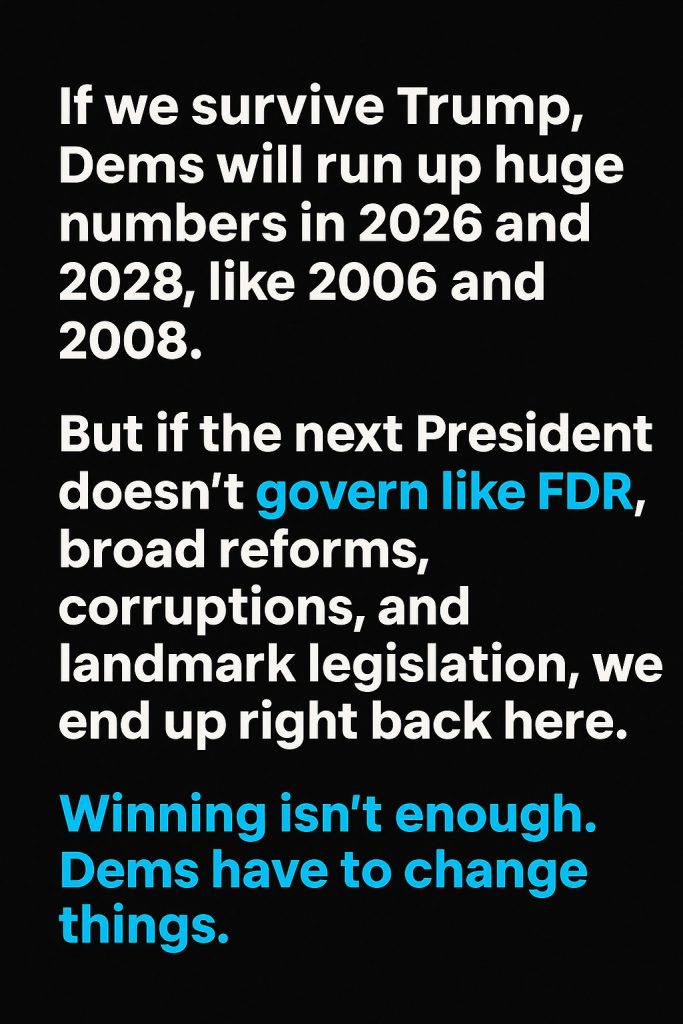
As the nation reflects on the turbulent years marked by former President Donald Trump’s influence on American politics, a viral social media post has sparked a renewed debate about the Democratic Party’s prospects in the upcoming 2026 and 2028 elections. The post offers a stark message: if the United States can weather the political storms of the Trump era, the Democrats are poised to reap substantial electoral rewards — similar to the impressive gains they secured in the 2006 and 2008 midterm and presidential elections, respectively.
The comparison is not merely nostalgic but grounded in historical precedent. The mid-2000s were a time of significant political backlash against the Republican Party, particularly as dissatisfaction grew around then-President George W. Bush’s administration, the Iraq War, and the 2008 financial crisis. The 2006 midterms saw Democrats capture a commanding majority in the House of Representatives, followed by Barack Obama’s sweeping victory in 2008, which ushered in a wave of hope and major policy shifts.
However, the social media message emphasizes a critical caveat: the next Democratic president must govern like Franklin D. Roosevelt (FDR), pursuing broad, transformative reforms to truly capitalize on this potential political momentum. FDR’s New Deal coalition forever reshaped American governance during the Great Depression, delivering sweeping economic, social, and regulatory changes that resonated with millions of Americans.
Many analysts agree that merely winning the White House and Congress isn’t enough to create a lasting electoral realignment. To replicate the scale of reform and political dominance seen under FDR, the next Democratic leadership would need to enact comprehensive policies addressing economic inequality, healthcare accessibility, climate change, and systemic racial injustices — among other pressing challenges.
Without such ambitious efforts, the enthusiasm seen at the ballot box could fade, much like the limited policy shifts after the 2018 midterms, when Democrats regained control of the House but struggled to advance a unifying legislative agenda.
This perspective has energized progressive voices who are calling on Democratic leaders to go beyond incrementalism and deliver bold government reforms. They argue that a failure to do so risks alienating core constituencies and squandering an opportunity to build a durable coalition that could hold power for over a decade.
Conversely, skeptics caution that the political environment remains deeply fractured, with rising polarization, economic uncertainty, and a highly energized opposition. They contend that even with strong reforms, replicating the mid-2000s “wave” could prove elusive without widespread voter mobilization and structural change to the electoral system.
Nevertheless, the viral commentary taps into a broader conversation about the future direction of the Democratic Party, the legacy of Trump’s presidency, and the pathways to substantive change in American governance. As 2026 and 2028 loom on the horizon, the coming years will be critical in determining whether Democrats can harness a wave of public desire for reform — or if the opportunity will slip away amid political headwinds.
In essence, the takeaway from the viral post and ongoing discussion is clear: surviving Trump’s political aftermath is only the first step. The next phase will demand bold leadership and visionary reforms if Democrats hope to replicate the historic successes of the mid-2000s and cultivate a new era of progressive governance.
Where to Learn More
- The Midterm Backlash: What History Tells Us About the 2022 Election – The New York Times
- The New Deal: An American Political Landmark – Brookings Institution
- FDR’s Legacy and Lessons for Today’s Progressives – NPR
- Can Democrats Build on 2022 Successes for 2026 and 2028? – CNN