
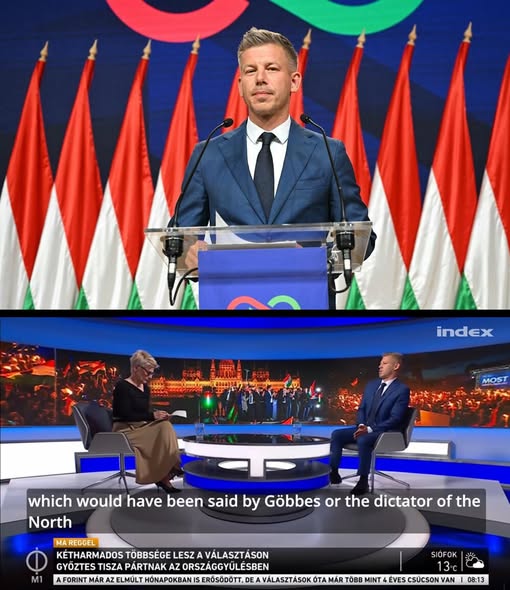
In a historic move that has sent shockwaves through Hungary and the global political landscape, incoming Prime Minister Peter Magyar has publicly confronted Hungary’s state media over years of alleged distortion and propaganda. Just days after securing a decisive electoral victory that ended Viktor Orbán’s 16-year rule, Magyar boldly stepped onto the set of M1, Hungary’s flagship state television channel, where he had been banned for over a year. Facing the cameras directly, he delivered a scathing critique that struck at the very heart of the country’s media landscape.
During the interview, Magyar did not hold back. He told the presenter that her outlet—and by extension, the entire state media apparatus—had spent years spreading “fear and despair”, deliberately shaping public opinion through misinformation and propaganda. In a moment that is being hailed as a watershed in Hungarian politics, Magyar declared that the current state broadcaster would be shut down and rebuilt into a truly independent, public service media.
“What has been built here,” Magyar said plainly, “is something Goebbels or the North Korean leadership would admire.” He added that not a single true word had been publicly spoken on the network for years. His words were direct, unvarnished, and resonant with a sense of accountability that most democratic societies aspire to but rarely see in practice.
The tone was set even earlier on election night, when Magyar addressed tens of thousands gathered along the Danube River. “Tonight, truth prevailed over lies,” he proclaimed, promising the Hungarian populace a “complete change of regime” and vowing to establish media standards that would rival or surpass those of the BBC. His pledge was clear: Hungary would shift from propaganda to transparency, restoring faith in its institutions and media.
In many ways, Magyar’s actions stand in stark contrast to the political climate in the United States, where similar efforts to challenge mainstream or state-aligned media are often met with political pushback or derision. Unlike the dogged deflections often seen here, Magyar’s confrontational approach signals a desire for integrity and accountability, even at the risk of political controversy.
This move is being perceived locally and internationally as a potential turning point for Hungarian democracy—a shift away from Orbán’s long-standing grip on power and propaganda, toward greater transparency and media independence. Critics see Magyar’s actions as a bold step towards restoring public trust, while supporters argue it signals a new era of accountability.
As Hungary embarks on this new chapter, the world watches eagerly: Can Magyar’s bold stance truly overhaul Hungarian media and politics? If so, it could serve as an inspiring example—and perhaps a wake-up call—to democracies worldwide that the fight for honest journalism and accountable leadership remains alive.
Where to Learn More
- Hungary’s New Leader Vows to Rebuild State TV as Independent Media – Bloomberg
- Hungary’s New Prime Minister Confronts State Media After Election Win – The New York Times
- Hungarian Prime Minister Pledges to Transform State Television into a Public Broadcaster – Reuters
- Hungary’s Political Shift and Media Reform – BBC