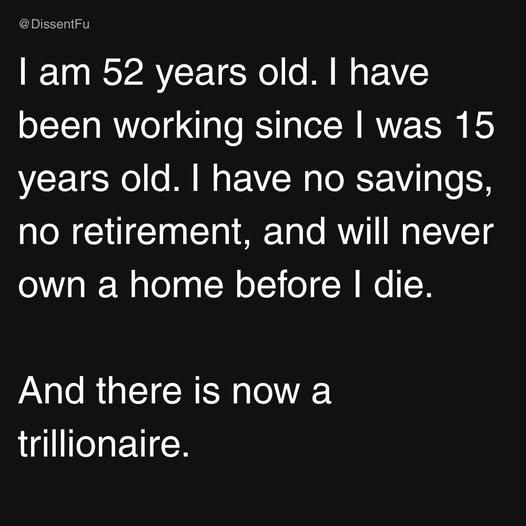
A poignant social media post has captured the attention of thousands, shedding light on the stark realities faced by many working Americans. In a heartfelt message that quickly went viral, a user identified as @DissentFu shared a lifetime of hardship, revealing that at 52 years old, they have been working since the age of 15 but still lack savings, retirement plans, and the prospect of owning a home before they pass away.
The post reads, “I am 52 years old. I have been working since I was 15 years old. I have no savings, no retirement, and will never own a home before I die.” This raw confession resonates deeply with many who feel trapped in a cycle of financial insecurity, unable to plan for the future despite decades of work.
What makes this story especially compelling is that it underscores a broader crisis facing millions of Americans. According to recent statistics, nearly 50% of adults in the U.S. have less than $10,000 in savings, and more than 20% have nothing set aside for retirement. Factors such as stagnant wages, rising living costs, and the decline of employer-sponsored retirement plans have left many workers ill-equipped for long-term financial stability.
Experts warn that stories like @DissentFu’s are not isolated cases, but symptomatic of systemic issues rooted in economic inequality. For many consumers, especially those in lower-income brackets or with precarious employment, the dream of financial independence feels increasingly distant. The reality is that living paycheck-to-paycheck leaves little room for savings, let alone investing in property or retirement accounts.
This viral post has reignited discussions about the need for comprehensive reforms, including raising the minimum wage, expanding access to affordable healthcare, and creating more robust social safety nets. Advocates argue that without policy changes, stories of hardship like this will become commonplace.
Social media users have responded passionately to @DissentFu’s open letter, sharing personal stories and advocating for systemic change. Many express frustration that decades of work sometimes still leave individuals vulnerable, highlighting disparities faced by marginalized communities and older workers who didn’t have access to better opportunities.
While the sentiment is somber, there’s a growing call to action for policymakers, employers, and community organizations to address these inequalities. The story underscores a crucial question: what does it truly mean to retire with dignity? For many Americans, the answer remains elusive.
Where to Learn More
- 2023 Report on the Economic Well-Being of U.S. Households – Federal Reserve
- Retirement Insecurity in America – Brookings Institution
- Why Many Americans Have Little Savings for Retirement – CNBC
- The Growing Retirement Savings Gap and Policy Solutions – National Bureau of Economic Research
- The Retirement Crisis in America – AARP