
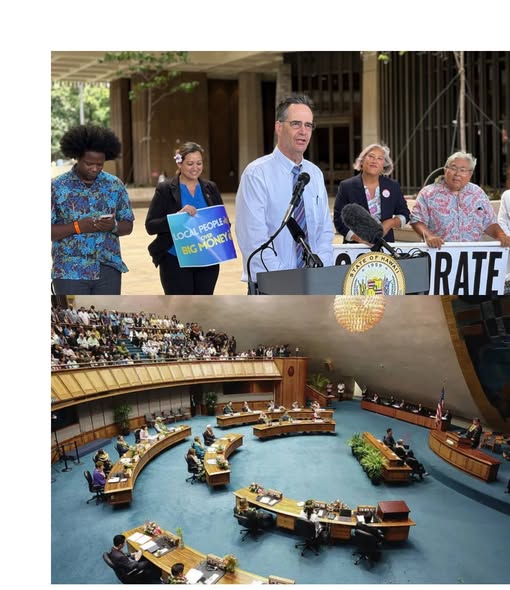
In a historic move that could reshape the future of American democracy, Hawaii has passed groundbreaking legislation asserting that corporations do not possess constitutional rights to influence politics through campaign contributions. The state’s Senate voted 24-0, and the House followed with a near-unanimous 50-1 vote, making it the first jurisdiction in the nation to officially challenge the legacy of the 2010 Supreme Court decision Citizens United v. Federal Election Commission.
Last Thursday, Hawaii Governor Josh Green signed Senate Bill 2471 into law, setting a new legal precedent that redefines corporations under Hawaiian law as *artificial persons* without inherent constitutional rights to make political donations. Effective July 1, 2027, the law explicitly states that corporations created by state law do not enjoy the same First Amendment protections that have, until now, allowed unlimited dark money to flood American elections.
Legal scholars and activists argue that Citizens United—a landmark ruling that equated corporate spending with free speech—has led to billions of dollars in opaque political spending, drowning out individual voters’ voices. Hawaii’s legislation challenges this by emphasizing that corporations are creations of the state, which grants them powers, and thus, their rights do not pre-exist the legal framework established by state law.
“Our rights as individual people don’t come from the government. They pre-exist the government,” stated State Senator Jarrett Keohokalole. “Corporations, on the other hand, are artificial beings. They possess only those properties which the charter of their creation confers upon them.”
This move has garnered widespread attention nationwide, especially as Montana prepares to introduce a similar ballot initiative inspired by Hawaii’s legislation. Additionally, fourteen other states have already begun drafting bills or gathering signatures to challenge the influence of big money in elections, signaling a potential wave of state-level resistance to corporate political spending.
Opponents, including many industry-backed lobbyists and political conservatives, have criticized the measure as a threat to free enterprise. However, proponents argue that such laws are crucial to restoring democratic integrity and ensuring that political power truly belongs to the people. “This law asks: who does our democracy belong to? Is it the people of Hawaii or the corporations created by the state?” questioned State Representative Kanani Souza.
The move in Hawaii marks a significant departure from the national trend, where the influence of dark money and corporate spending continues to dominate elections. As the state leads the charge, American democracy may be on the cusp of a transformative shift—one that redefines the balance of power between citizens and the artificial entities that have long wielded influence over their future.