
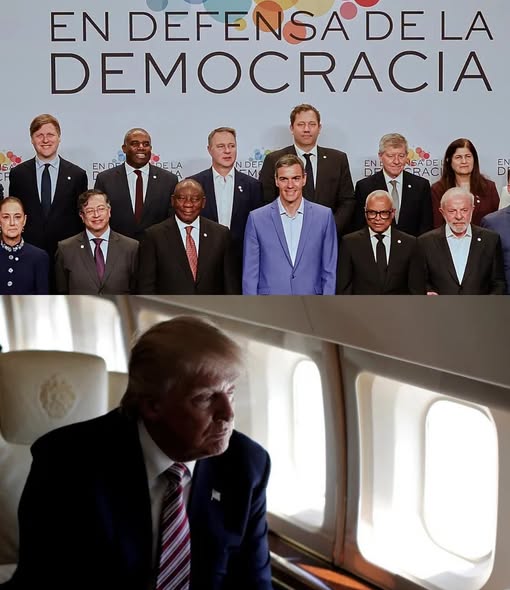
This week, the world sent a resounding message: it is uniting against former U.S. President Donald Trump and his influence on global politics. On Saturday, a high-profile summit in Barcelona became the stage for an unprecedented coalition of leaders representing multiple continents, signaling a collective desire to push back against what many see as a destabilizing force in international affairs.
The summit, held specifically to counter Trump’s policies and rhetoric, saw the heads of state from Mexico, Brazil, Spain, Colombia, South Africa, and Uruguay standing shoulder to shoulder in a powerful display of solidarity. Spanish Prime Minister Pedro Sánchez addressed the crowd with clear resolve, stating, “They know their vision of how the world should be ordered is falling apart. From now on, they can be the ones who feel ashamed.” This bold declaration underscored a shared belief among these nations that Trump’s influence is waning, and that a new global order is emerging.
Notably, Mexico and Spain set aside longstanding historical disputes—particularly colonial disagreements—by shaking hands for the first time in years during the summit. Their gesture symbolized a broader rejection of divisive nationalism and an embrace of cooperative diplomacy in opposition to what these leaders view as harmful populism championed by Trump.
Brazil’s President Luiz Inácio Lula da Silva further amplified this sentiment, criticizing the United Nations’ credibility amid what he called “a broken system,” explaining, “the countries that created it do not respect it.” His pointed remarks, widely seen as directed at Trump, reflect a growing frustration among global leaders about multilateral institutions and their effectiveness.
Meanwhile, Trump responded to these diplomatic developments with a surge of social media attacks aimed at Sánchez, attempting to undermine the coalition, but only highlighting his isolation. Many Western counterparts are distancing themselves from him, as seen in Canada’s recent political shift. Prime Minister Mark Carney, who secured a parliamentary majority by explicitly opposing Trump’s policies, declared at the World Economic Forum in Davos that “the old order is not coming back,” signaling a tectonic shift in global geopolitics.
Across Europe, Trump’s influence appears to be weakening. In Hungary, Prime Minister Viktor Orbán’s close ally lost a landslide election, and Trump’s efforts to support him fell short. Trump’s endorsement of Hungarian politician Vance fell flat, despite the former president’s public pledge of support. European far-right figures like Nigel Farage and Italy’s Giorgia Meloni are also increasingly distancing themselves from Trump, realizing that being associated with him has become politically costly.
Additional signs of waning American influence include protests and diplomatic tensions. In Ireland, a protester at Shannon Airport attempted to attack a U.S. military aircraft with a hatchet, while Spain closed its airspace to American warplanes amidst rising protests. NATO allies have refused to send ships to contested areas like the Strait of Hormuz, despite direct White House demands—an unprecedented act of defiance symbolizing the crumbling of traditional alliances.
Amid these tumultuous developments, the Pope openly expressed confidence, stating, “I have no fear of the Trump administration, or speaking out loudly,” highlighting the growing global skepticism about America’s direction under Trump’s influence.
Back in the United States, contrasting scenes took place in New York’s Bronx, where a relaxed Barack Obama was spotted reading to young children at a childcare center, just days after Trump claimed the government couldn’t afford daycare programs. This simple act served as a poignant reminder: the world’s most powerful man is increasingly losing ground in the court of public opinion and diplomatic influence.
As these global shifts unfold, it’s clear that broad international consensus is forming—a collective pushback against Trump’s legacy and what many see as outdated approaches to governance and diplomacy. The coming months will reveal whether this united front can sustain itself or if global politics will once again shift in unexpected ways.