
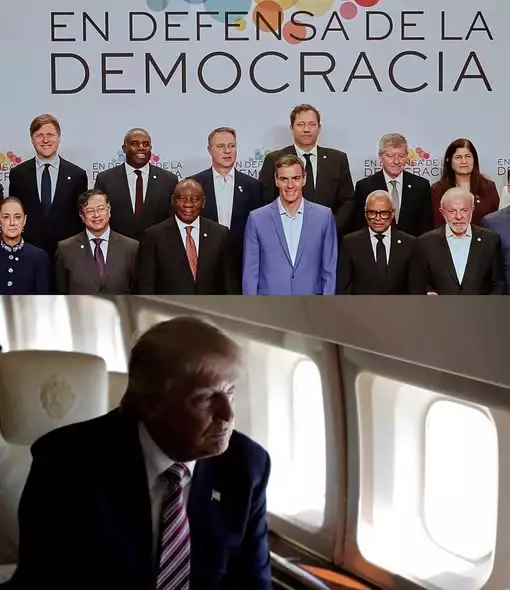
In a striking display of international solidarity, the world’s political landscape is increasingly turning against former U.S. President Donald Trump. This week culminated in a high-profile summit held in Barcelona, where leaders from Mexico, Brazil, Spain, Colombia, South Africa, and Uruguay gathered with a clear purpose: to oppose Trump’s rising influence and challenge his global narrative.
Spain’s Prime Minister Pedro Sánchez opened the summit with a pointed message to the gathering: “They know their vision of how the world should be ordered is falling apart. From now on, they can be the ones who feel ashamed.” This bold statement underscored a broader mood shared among the attendees — that Trump’s worldview is increasingly marginalized and losing ground on the global stage. Notably, Sánchez and Mexico’s President Andrés Manuel López Obrador made history with a handshake, mending longstanding colonial disputes and symbolizing a united front against divisive rhetoric.
Brazil’s Luiz Inácio Lula da Silva added fuel to the fire, criticizing the credibility of the United Nations as “broken,” alleging that “the countries that created it do not respect it.” His comments appeared to target Trump directly, hinting at a broader disillusionment with U.S. leadership and international institutions. Trump responded swiftly, attacking Sánchez on social media and doubling down on his contentious rhetoric.
The shifting political landscape extends beyond the summit. Canada’s Prime Minister Mark Carney, who recently converted a minority government into a majority by explicitly opposing Trump’s policies, warned at the World Economic Forum in Davos that the world faces “a rupture, not a transition.” He emphasized that the “old order” is no longer viable, signaling a potential shift toward new global alliances and strategies.
European dynamics are also shifting. Trump’s European allies are distancing themselves; Hungary’s ruling party recently suffered a significant electoral defeat, and Donald Trump’s influence in European far-right circles appears waning. Notably, controversial figures like Nigel Farage and Italy’s Giorgia Meloni are pulling away from the former U.S. leader, recognizing that aligning too closely might damage their political standing.
At the same time, protests and diplomatic responses underscore the palpable decline of American influence. In Ireland, a protester attacked a U.S. military aircraft at Shannon Airport with a hatchet, while Spain closed its airspace to American warplanes amid rising tensions. NATO allies have also refused to comply with U.S. demands to send ships to the Strait of Hormuz, signaling a reluctance to serve as U.S. military enforcers in key strategic regions.
Amid these developments, even the Pope voiced his stance, telling reporters en route to Africa: “I have no fear of the Trump administration, or speaking out loudly.” Meanwhile, in the Bronx, former President Barack Obama was captured reading to young children at a childcare center, exemplifying a contrast to Trump’s recent proposals on government spending for early childhood education.
Collectively, these signals suggest that Donald Trump’s grip on global political influence is fraying across every conceivable front. As alliances shift and nations express their discontent openly, the world is witnessing a remarkable move away from Trump-era policies and sentiment, pointing toward a potential reordering of international relations in the years to come.
Where to Learn More
- European Leaders Coalesce Against Trump at Barcelona Summit – The New York Times
- World Turns Away From Trump: The Shifting Global Power Dynamics – Al Jazeera
- European Far-Right Retreats from Trump’s Influence, Polls Show – BBC News
- Obama Reads to Children in Bronx as Trump’s Influence diminishes – CNN
- Trump Attacks European Leaders on Social Media Amid Declining Support – The White House