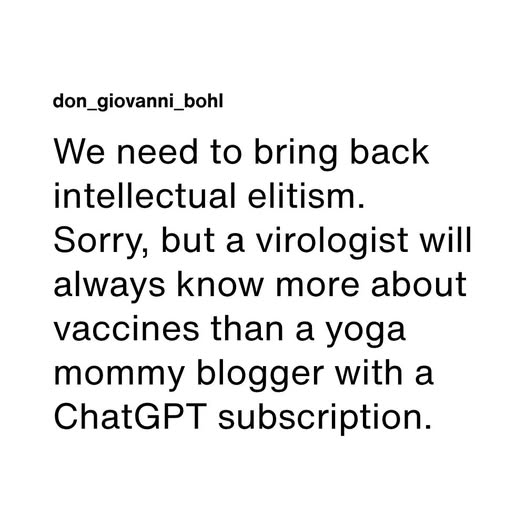
In an era where social media has become the primary source of information for millions, a rising concern among scientists and intellectuals is the erosion of respect for specialized knowledge. A recent social media post boldly asserted, “We need to bring back intellectual elitism. Sorry, but a virologist will always know more about vaccines than a yoga mommy blogger with a ChatGPT.”
This statement captures a broader debate about the value of expertise versus popular opinion. While democratization of information has its benefits, experts warn it can also lead to dangerous misconceptions, especially in critical fields like medicine and science. The post, which quickly went viral, sparked widespread reactions, with some applauding the call for valuing expert knowledge, while others criticized it as elitist and dismissive of alternative perspectives.
Dr. Susan Carter, a public health expert at Johns Hopkins University, emphasizes the importance of trusting qualified professionals. “When it comes to vaccines, infectious disease modeling, or pandemic response, the expertise of trained virologists and epidemiologists outweighs lay opinions,” she says. More on COVID-19 research and vaccine development.
Conversely, critics argue that framing certain knowledge as inherently superior can create barriers to open dialogue and contribute to public distrust. Social media influencers with large followings, including lifestyle bloggers and non-traditional content creators, often reach audiences that might not engage with scientific publications. While their perspectives are valuable in many contexts, experts contend that complex issues like vaccines require nuanced understanding rooted in scientific methodology.
Some experts caution against the dangerous oversimplification of expertise. Dr. Michael Liu, a philosopher of science, emphasizes the importance of critical thinking and interdisciplinary dialogue. “It’s not about dismissing non-experts but recognizing that certain fields demand rigorous training and evidence-based assessment,” he explains. The Stanford Encyclopedia of Philosophy on scientific knowledge.
The debate also touches on the broader effects of misinformation in public health. During the COVID-19 pandemic, false claims and skepticism from non-experts contributed to vaccine hesitancy and resistance to public health measures. Experts argue that empowering the public with accurate information from credible sources is crucial, but so is respecting the boundaries of expertise.
As social media continues to evolve, fostering a culture that values knowledge without dismissing personal experiences remains a challenge. Promoting science literacy, encouraging respectful discourse, and recognizing the importance of specialized training are vital steps forward.