
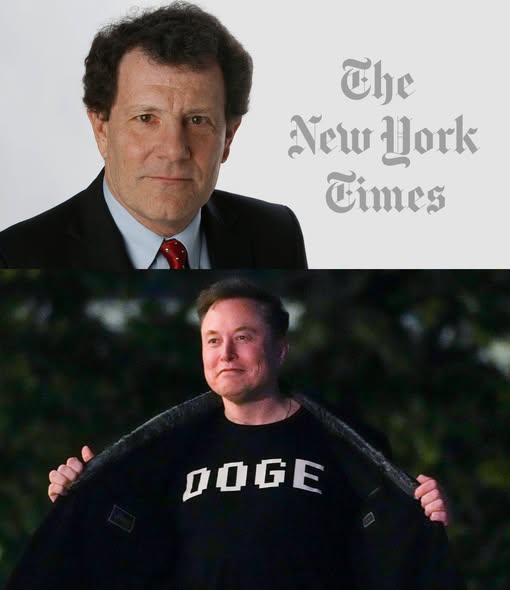
In a fiery social media exchange that has ignited global attention, billionaire Elon Musk found himself on the defensive after a challenge from New York Times columnist Nicholas Kristof regarding the humanitarian impact of recent USAID budget cuts. The debate took a dramatic turn when Kristof didn’t just dispute Musk’s claims—he delivered the names, ages, and villages of individuals who have allegedly died because critical aid funding was slashed.
The controversy began when Musk, known for his outspoken stance on economic and political issues, challenged critics to name a single person who had died due to his claims that USAID cuts could kill millions of children. When Rep. Ro Khanna cited research indicating that dismantling USAID could threaten millions more—including countless children—Musk fired back with a dismissive challenge: “Not a single name!”
Seizing the moment, Kristof responded with heartbreaking specifics. “An 8-year-old girl in South Sudan died after her HIV medication funding disappeared,” he wrote. “A baby in Liberia succumbed to malaria, and a 23-year-old woman bled out during childbirth because ambulances could no longer get diesel funding.” With each example, Kristof emphasized that in “almost every village” across conflict-ridden regions like South Sudan, Uganda, Liberia, and Sierra Leone, lives are being lost directly because aid has dried up, adding, “We were saving one life every 10 seconds with USAID, and that was abruptly cut off, leaving children to die unnecessarily.”
He extended an open invitation to Musk, suggesting that a firsthand reporting trip could reveal the truth. “Come with me,” Kristof challenged, “Talk to parents, see the dying children—experience the consequences firsthand.”
Unfazed, Musk responded with vitriol. He called Kristof “an utter piece of sh!t and a liar,” and accused him of spreading falsehoods—misspelling his name in the process. Musk further suggested legal action, tweeting: “Time to sue this liar,” alongside an unsubstantiated image purportedly showing militants with USAID-branded shelter materials, with the caption, “This is how USAID spent your tax dollars.” The image, however, lacked verifiable evidence to support its claim.
Throughout the exchange, Musk failed to address or dispute any specific names Kristof presented, instead opting for personal insults and unproven allegations. Meanwhile, data from reputable sources paints a grim reality: Zimbabwe’s health authorities reported a doubling of malaria deaths early in 2026, and a Lancet study projects that continued aid cuts could result in over 4.5 million child deaths by 2030. These numbers aren’t abstract—they correspond to individual lives, ages, and villages, many of which Kristof has documented extensively.
In this standoff, facts speak louder than rhetoric. The evidence indicates that aid reductions are causing tangible human suffering—especially among vulnerable children—despite Musk’s dismissals. As the debate continues, the question remains: will influential voices like Musk’s acknowledge the human toll, or will aid and compassion be sacrificed in political and social battles?