
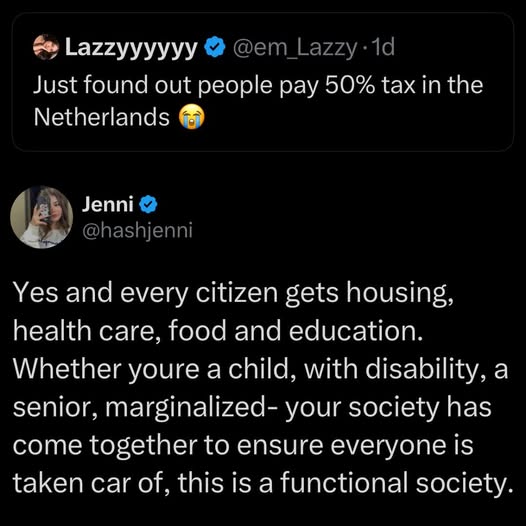
In a viral social media post that has sparked widespread curiosity and debate, online users are buzzing over a startling revelation about the Dutch tax system. The post, which features an image of text claiming that “people pay 50% tax in the Netherlands,” has prompted many to question the true extent of taxation in the country.
The post originated from an account with the handle @em_Lazzy, who expressed their surprise at discovering what they believe is a significant tax burden in the Netherlands. The tweet reads: “Just found out people pay 50% tax in the Netherlands.” This statement ignited a flurry of responses, including one from @hashjenni, who added that “every citizen gets a house,” suggesting that the social benefits associated with Dutch taxes might overshadow the high rates for some individuals.
However, this social media exchange has raised important questions about the accuracy of these claims. While the Netherlands does have relatively high tax rates—particularly for higher earners—the idea that all citizens pay a flat 50% tax oversimplifies the complex tax system. According to official data from the Dutch government, the tax brackets for income tax vary, with rates ranging from approximately 37% to 49.5% for the highest earners, depending on income levels and deductions.
It’s important to note that “taxes” in the Netherlands encompass a broad spectrum of contributions, including income tax, social security, national insurance, and value-added tax (VAT). Each plays a role in funding the country’s robust social welfare programs, healthcare, education, and infrastructure. For instance, employees pay progressive income taxes, but they also benefit from publicly funded healthcare and education systems, which are often subsidized through these taxes.
The misconception likely stems from a misunderstanding or specific interpretation of the top marginal tax rate, which can approach nearly 50%. Yet, this rate does not necessarily reflect what the average citizen actually pays overall. Many Dutch residents pay significantly less after deductions, credits, and social contributions are factored in. Moreover, the country is known for its extensive social safety nets, including high-quality healthcare, free or affordable higher education, and generous paid parental leave—benefits made possible through these taxes.
This social media moment emphasizes how quickly misinformation can spread online, especially when complex topics like taxation are distilled into simple, eye-catching claims. It’s a reminder for readers to verify facts and understand the broader context behind numbers that often seem straightforward but are ultimately part of a nuanced fiscal system.