
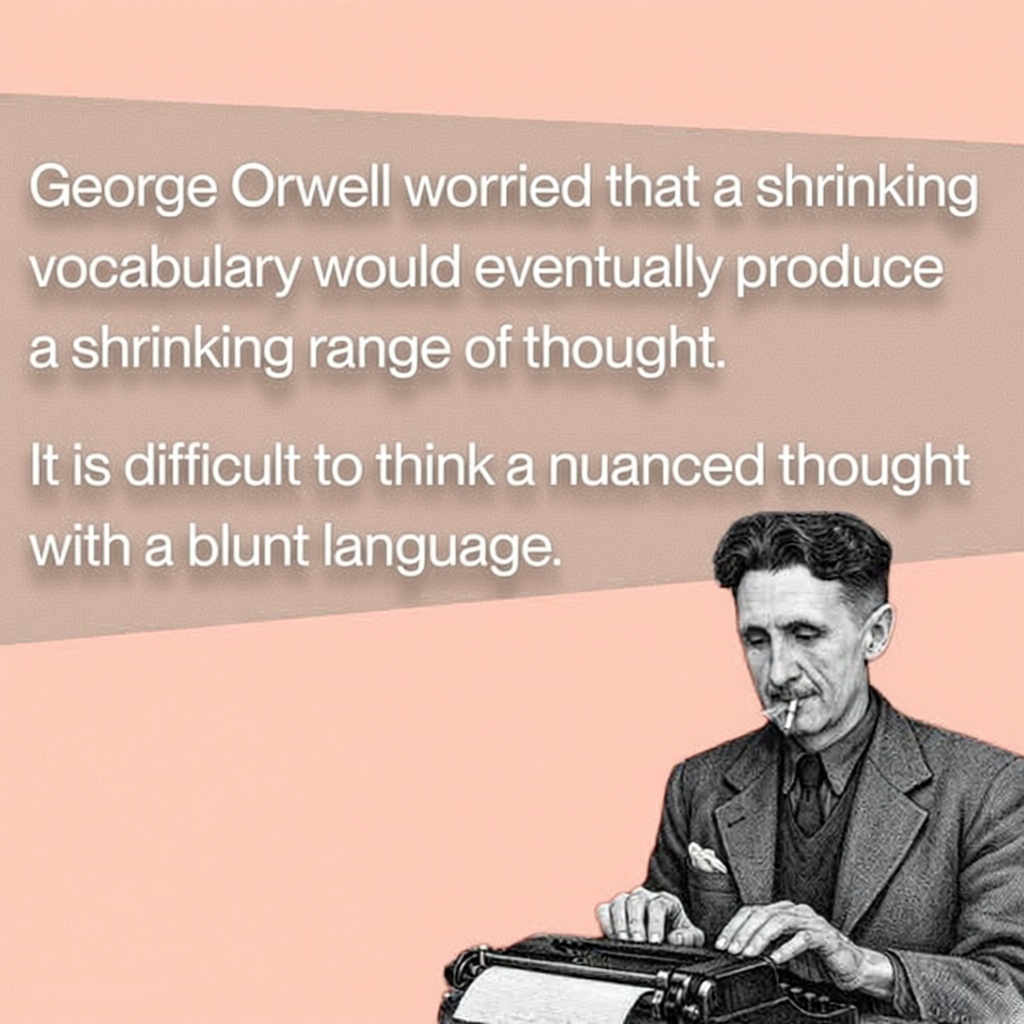
In an era where social media often emphasizes brevity over depth, some experts warn that our shrinking vocabulary could be shaping the way we think — potentially limiting our capacity for nuanced understanding and critical reasoning. A viral social media post has reignited the debate, featuring a poignant quote attributed to the famed novelist George Orwell: “Orwell worried that a shrinking vocabulary would ultimately produce a shrinking range of thought.”
The post references a graphic that underscores Orwell’s concerns, suggesting that as words become fewer and simpler, our ability to express complex ideas diminishes. This concept resonates with many psychologists, linguists, and educators who argue that language is not just a tool for communication but also a crucial foundation for thought itself.
Why does vocabulary matter? Language shapes our mental processes. The richness and diversity of words available to us influence how accurately we can articulate and understand complex concepts. When our vocabulary narrows, so too may our understanding of nuanced topics such as morality, politics, or emotional experiences. This phenomenon is often called the linguistic relativity hypothesis, which suggests that language influences thought.
In recent years, the rise of social media platforms like Twitter and TikTok has popularized short-form content, often characterized by abbreviations, emojis, and simplified language. While efficient for quick communication, critics argue that this trend could be detrimental to our cognitive depth. A limited vocabulary might make it harder to think critically, evaluate subtle differences, or engage in sophisticated reasoning.
Some researchers point to the declining use of complex vocabulary in everyday conversations and educational materials. Data shows that younger generations tend to use a narrower range of expressive words compared to previous generations. This linguistic compression might influence everything from academic performance to social empathy, as the ability to understand and discuss nuanced perspectives becomes more challenging.
However, others contend that language adapts to societal needs, and that simplicity can enable broader accessibility and inclusiveness. Yet, they also acknowledge that maintaining a vibrant vocabulary is essential for intellectual growth. As writer and linguist David Crystal notes, “The richness of our vocabulary is a reflection of the richness of our culture and thought.”
So, what can be done? Educators and linguists advocate for promoting vocabulary development through reading, diverse conversations, and lifelong learning. They stress that fostering an environment where complex language is valued and encouraged can help preserve our capacity for deep and critical thinking amid the digital age.
Ultimately, Orwell’s ancient warning seems more relevant than ever. In a world of ever-shrinking word banks, the challenge is to ensure that our thoughts remain as expansive as our words should be. Sustaining a rich vocabulary is not just about language mastery — it’s about safeguarding ourselves from a future where thinking itself becomes constricted.
Where to Learn More
- Linguistic Relativity Hypothesis – Encyclopaedia Britannica
- Vocabulary and Cognitive Development – Cambridge University
- Language and Thought: Is a Limited Vocabulary Limiting Our Thinking? – The New York Times
- The Impact of Social Media on Language and Thought – The Washington Post
- The Future of Language — TED Talk by David Crystal