
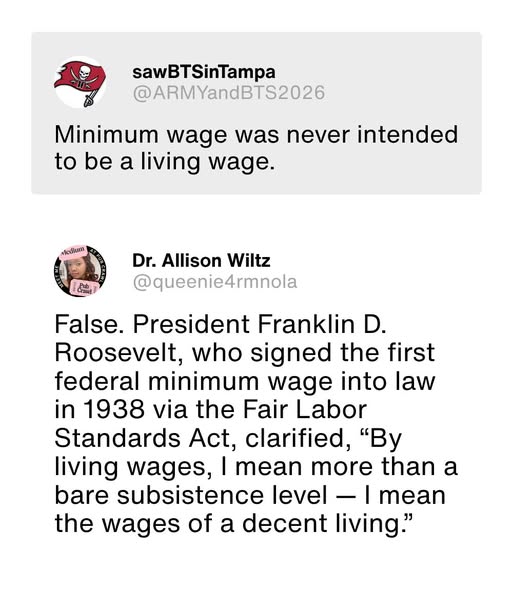
In recent social media debates, a viral post claimed that “minimum wage was never intended to be a living wage,” prompting widespread discussion and confusion about the origins of minimum wage policies in the United States. The post, which cites an alleged quote from Dr. Allison Wiltz, has been shared by many, including fans of popular K-pop group BTS and loyal members of the ARMY fandom, highlighting how misinformation can spread quickly even on seemingly unrelated topics.
However, history tells a different story. The assertion that minimum wage was never meant to serve as a living wage is a misconception. In fact, the origins of minimum wage legislation are rooted in efforts to uplift workers’ standard of living, not merely to set arbitrary wage floors.
The Fair Labor Standards Act of 1938, which established the federal minimum wage, was enacted during President Franklin D. Roosevelt’s New Deal era—a period marked by extensive reforms aimed at economic recovery and social justice. Roosevelt believed that ensuring fair wages was crucial for combating poverty and promoting economic stability. While it’s true that the initial minimum wage was set at a level designed to help workers meet basic needs, debate persists on whether it has kept pace with the rising cost of living.
This misconception may have arisen from nuances in the policy’s language or from misinterpretations of historical documents. Some critics argue that the minimum wage is a starting point, not a comprehensive measure for a decent standard of living. Yet, many economists and historians agree that the original intent was to improve living conditions, making work a pathway out of poverty rather than a perpetuity of hardship.
Additionally, statements like those attributed to Dr. Wiltz, a health equity researcher, should be examined critically. It’s always beneficial to fact-check social media claims, especially when they appear to oversimplify complex policy histories. Relying on reputable historical sources and official records offers a clearer picture of the motivations behind minimum wage laws.
This debate underscores a broader question: what is the true purpose of minimum wage laws today? Many advocate for raising the minimum wage to a living wage—an income level that covers essentials such as housing, healthcare, and transportation. As the economy evolves, so too must our understanding and implementation of fair wages, rooted in the original goal of fostering economic justice for all workers.
Where to Learn More
- History of the Minimum Wage in America – History.com
- The Impact of Minimum Wage on Employment and Income Inequality – Federal Reserve
- Fact Sheet: What the Minimum Wage Entails Today – National Employment Law Project
- FDR and the Fight for Fair Wages – Roosevelt House