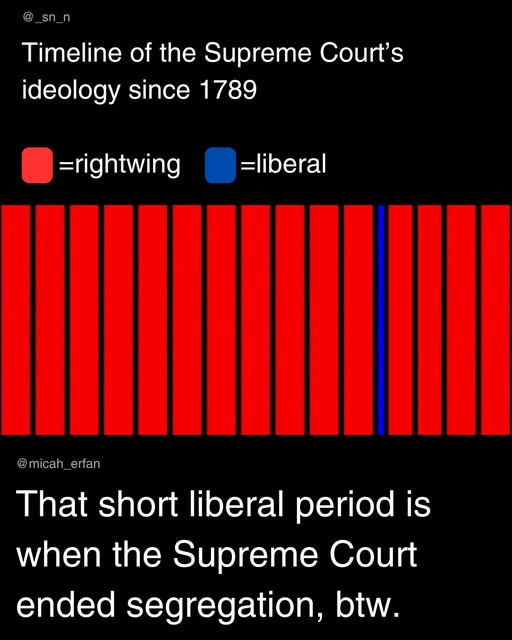
Social media has increasingly become a battleground for political debates and historical narratives, often blurring the lines between fact and fiction. Recently, an image circulating online claims to depict a “Timeline of the Supreme Court’s ideology since 1789,” suggesting a simplistic binary of “right-wing” and “liberal” periods. The image further states that the so-called ‘short liberal period’ was when the Court ended segregation, implying a limited scope of liberal influence. But how accurate is this portrayal? Let’s delve into the history of the Supreme Court and its ideological shifts to better understand the truth.
First, it’s important to recognize that the Supreme Court’s decisions and ideological leanings are complex and cannot be fully captured by a straightforward timeline that labels entire eras as simply ‘right-wing’ or ‘liberal.’ The court’s composition has fluctuated over centuries, influenced by appointments, societal norms, and legal interpretations that often transcend partisan labels.
The claim that the Court entered a “short liberal period” ending segregation references a significant chapter in U.S. history. From the 1930s through the 1960s, the Supreme Court notably expanded civil rights protections, notably with landmark decisions such as Brown v. Board of Education (1954), which declared racial segregation in public schools unconstitutional. This period is often regarded as a time of progressive, or ‘liberal,’ influence reshaping social justice in America.
However, characterizing this as the sole liberal era ignores important aspects of the Court’s earlier and later decisions. For example, the Court’s early 19th-century rulings were often conservative, reinforcing property rights and state sovereignty. The political ideology of justices has historically swung back and forth, influenced by presidential appointments and prevailing political climates.
More recently, debates around the Court’s ideology continue, with some perceiving recent rulings as conservative shifts, especially on issues like voting rights, reproductive rights, and environmental regulations. Yet, labeling the entire history as a dichotomy oversimplifies the nuanced judicial philosophy that varies case by case.
Additionally, it’s crucial to approach social media claims with a healthy dose of skepticism. While visual timelines are engaging, they often exclude important context, nuances, and the complexities behind judicial decisions. Recognizing this helps readers develop a more informed view of our judiciary’s evolution over time.
In sum, the history of the Supreme Court’s ideology is a rich, layered story that defies mere binary classifications. Understanding this nuanced history is essential for anyone seeking to grasp how the Court has shaped American society—and how it continues to do so today.