
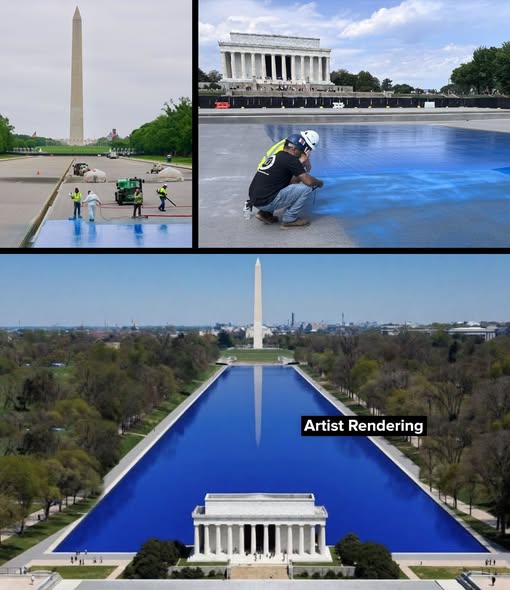
America woke up on Friday to a startling scene that quickly made waves across social media and news outlets: workers coating the historic Lincoln Memorial Reflecting Pool with an unconventional, industrial-grade surface dubbed “American flag blue.” This bold move, reportedly orchestrated directly by former President Donald Trump, has ignited a firestorm of debate over preservation, presidential overreach, and public aesthetics.
The Reflecting Pool, an iconic feature of the National Mall and a backdrop for Martin Luther King Jr.’s legendary “I Have a Dream” speech, has long been celebrated for its reflective qualities—its dark surface mirroring the sky, the Lincoln Memorial, and the surrounding architecture. Its recent makeover, however, involves covering the bottom with a bright, pool-blue coating, transforming what was once a silent mirror into a giant decorative puddle. The new color, which Trump has called “American flag blue,” has raised eyebrows among historians, preservationists, and concerned citizens alike.
This latest renovation appears to be part of a broader pattern of unilateral, top-down upgrades initiated by Trump—actions often taken without public input, historic preservation reviews, or transparency. The changes echo past episodes, such as the sudden, unexplained construction at the White House East Wing or the unannounced embellishments to the Kennedy Center, which were often announced directly on social media or through private channels rather than official public consultation.
Sources suggest that Trump personally called contractors—his “go-to” crew—much like calling a buddy to redo a backyard project. The lack of formal planning or public notification raises concerns about safeguarding America’s historic landmarks and the cultural significance they embody. Critics argue that the change not only undermines the aesthetics of a site intimately linked to the Civil Rights Movement but also reflects a broader trend of eroding historic integrity for the sake of personal aesthetic and political branding.
Ironically, Trump has long styled himself as the embodiment of rugged American masculinity and traditional values. Yet, his penchant for redacting history and transforming iconic sites into his personal statement stands in stark contrast to that image. From redecoration of the Rose Garden and Oval Office to the splattering of his name across federal landmarks, critics see these actions as territorial markings—akin to a feral dog claiming a yard, but on a national scale.
Many hope that, someday, clear efforts will undo or at least mitigate these recent alterations—restoring historic sites to their original state and preserving their cultural power. The question remains whether future administrations will prioritize history or continue this cycle of impulsive rebranding. As Americans watch these developments unfold, the hope is for a renewed focus on protecting the nation’s treasured landmarks from unnecessary and superficial modifications.
Where to Learn More
- National Park Service: Preservation and Restoration Guidelines – NPS
- Washington Post: Controversies over Presidential Renovations
- National Archives: Protecting America’s Historic Landmarks
- National Geographic: The History of the Lincoln Memorial Reflecting Pool
- New York Times: Debates Over Preservation and Political Influence