New investigations reveal alarming discrepancies in the Pentagon’s reporting of U.S. casualties in the Middle East, raising critical questions about transparency and accountability. Despite official statements downplaying troop injuries and deaths, multiple sources expose what a defense official has branded a “casualty cover-up.”
The Intercept has conducted two in-depth investigations highlighting these inconsistencies. According to their findings, the Pentagon’s casualty tracking system presents conflicting numbers, sometimes within the same day. One government webpage lists 372 troops wounded, while another lists 357. Central Command—responsible for military operations in the region—reported an even lower figure of 303. All of these numbers, however, fail to fully capture the scope of injuries suffered by service members.
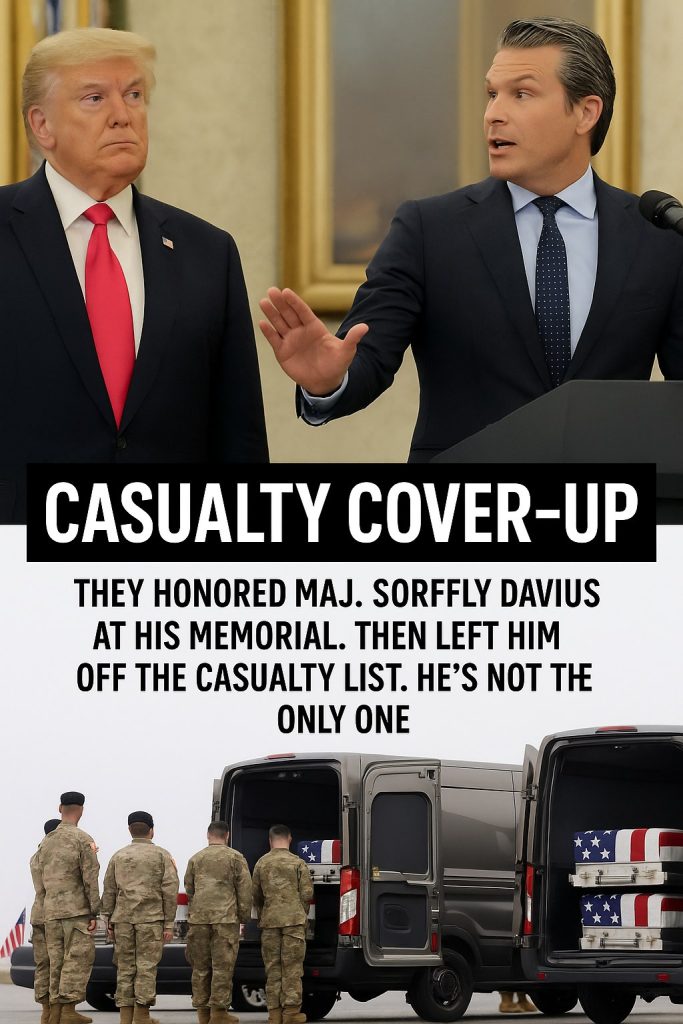
An estimated 200 sailors injured aboard the USS Gerald R. Ford following a fire—suffering smoke inhalation and lacerations—have not been accounted for in official casualty counts. Similarly, Maj. Sorffly Davius, an Air Force officer who died of sudden illness while deployed to Kuwait and was publicly honored by senior military leaders, is mysteriously absent from the casualty list maintained by the Pentagon.
In another stark example, an Air Force officer rescued from behind enemy lines in Iran sustained serious injuries, described by former President Trump as “bleeding rather profusely” and “injured quite badly.” Yet, the Pentagon claims there were “zero American casualties” during that mission.
Former Pentagon officials and analysts say these discrepancies are not only misleading but indicative of a broader culture of obfuscation regarding troop welfare. Controversial remarks from Fox News host Pete Hegseth asserting that no troops have been put in harm’s way contrast sharply with accounts that the Department of Defense failed to adequately protect service members, who were forced to seek shelter in hotels and secure facilities during attacks.
This pattern of underreporting echoes the aftermath of Iran’s attack on Al-Asad Air Base during Trump’s first term when the president initially claimed “no Americans were harmed.” It was later revealed that over 110 troops had suffered traumatic brain injuries (TBIs), injuries dismissed by Trump as mere “headaches.”
The Army—charged with operating interceptor missile systems across the Middle East—has endured the highest number of wounded personnel, with official counts listing 251 wounded. Yet, it was only recently that the Army began seeking advanced sensors to detect blast overpressure injuries linked to TBIs.
This gap in preparedness means troops have been vulnerable to unseen and potentially lifelong injuries. Moreover, if disability claims from the current cohort of roughly 50,000 deployed troops mirror rates from the Gulf War veterans, the Pentagon faces a looming financial burden exceeding $600 billion over affected lifetimes. The current supplemental war funding request of $200 billion is just the tip of the iceberg, with the true cost possibly climbing into the trillions.
The ongoing issues raise urgent questions: How many more troops are suffering unreported injuries? Why has the Pentagon repeatedly failed to maintain consistent and transparent casualty records? And what safeguards are being put in place for the health and well-being of service members and their families, many of whom have already endured displacement and trauma?
As these revelations circulate widely on social media and mainstream news outlets, insistence on accurate, honest casualty accounting is gaining momentum among lawmakers, veterans’ groups, and military families. The calls are clear—transparency in wartime casualty reporting is not just a matter of numbers but a critical aspect of honoring those who serve.
Where to Learn More
- Pentagon’s Missing War Casualties: An Investigation – The Intercept
- Casualty Cover-Up? Conflicting Military Injury Counts Exposed – The Intercept
- Department of Defense News Releases – U.S. Department of Defense
- Army Seeks New Sensors to Identify Blast Injuries – ABC News