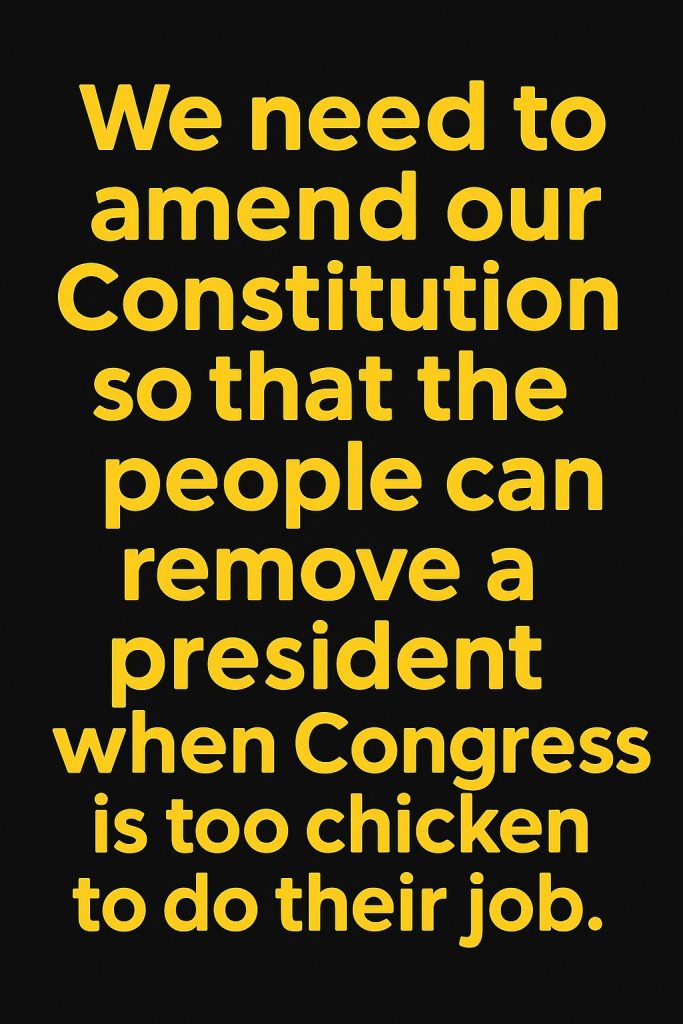
A recent viral social media statement has reignited debate over the balance of power in the U.S. government, highlighting growing frustration with Congress’s perceived unwillingness to hold the president accountable. The text, which reads, “We need to amend our Constitution SO that the people can remove the president when Congress is too chicken shit to do their job,” has struck a chord across various online platforms and sparked discussions about constitutional reform.
The phrase captures a widespread sentiment among a portion of the American public who feel that the mechanisms currently in place to check presidential power, primarily impeachment proceedings conducted by Congress, are insufficient or hindered by political gridlock and partisanship. This viral message advocates for a more direct role for citizens in removing a sitting president, bypassing what some view as an obstructive Congress.
Understanding the Current System
Under the United States Constitution, the removal of a president is primarily a congressional responsibility. The House of Representatives holds the power to impeach, or formally charge, the president with “high crimes and misdemeanors,” while the Senate conducts the subsequent trial to decide whether to remove the president from office. This two-step process requires a majority vote in the House and a two-thirds majority in the Senate to complete removal.
This structure was intentionally designed to provide both a mechanism for accountability and a significant safeguard against impulsive or politically motivated removals. However, critics argue that it can lead to inaction when political loyalties interfere with objective assessments of presidential misconduct.
The Case for Constitutional Amendment
Proponents of a constitutional amendment for direct presidential removal by the people assert that such a change would restore power to citizens and strengthen democratic accountability. This could take the form of a national referendum or a direct recall mechanism similar to those used in some states for elected officials at local or state levels.
Advocates argue that when Congress fails to act—whether due to fear, political calculations, or partisanship—the people should have the authority to intervene directly. The viral text underscores a political frustration many feel, reflecting an anxiety about governance and a yearning for more immediate remedies when leadership is perceived as failing.
Challenges and Considerations
However, constitutional amendments are notoriously challenging to enact. They require not only proposal by two-thirds of both the House and Senate or a constitutional convention called by two-thirds of state legislatures but also ratification by three-fourths of the states. Additionally, introducing a direct removal process raises complex questions about national stability, the potential for abuse, and the balance of power among the branches of government.
Legal scholars warn that bypassing the legislative branch for removal could undermine the foundational system of checks and balances. Critics of such an amendment caution that recall elections at the presidential level could lead to volatility, frequent challenges, and distract from governing, especially in highly polarized climates.
The Broader Context
These discussions occur against a backdrop of intense political polarization, where the ability of Congress to act decisively on issues related to the presidency is increasingly questioned. The viral message reflects a broader movement questioning institutional effectiveness and seeking reforms that give the electorate more direct democratic power.
Whether this viral sentiment translates into concrete political action remains to be seen. Still, it undeniably highlights a critical conversation about democratic accountability and the evolving relationship between the American people, their elected representatives, and the presidency.
As the debate continues, citizens, lawmakers, and constitutional experts alike will weigh the benefits and risks of empowering the electorate with direct presidential removal—considerations that go to the heart of American democracy.
Where to Learn More
- Could the American People Remove the President? – Brookings Institution
- Impeachment and Removal – National Constitution Center
- The Congressional Impeachment Process – Lawfare
- Debate Over Presidential Recall Grows – The New York Times
- The Constitution and the Power of the President – C-SPAN