
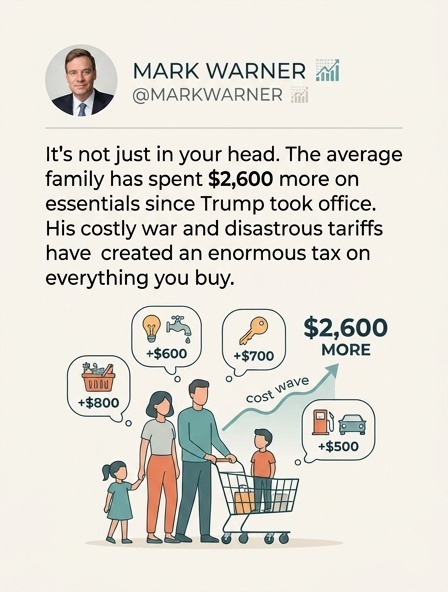
As the cost of daily necessities continues to climb, a recent viral social media post has spotlighted a significant economic concern: the average American family is now spending approximately $2,600 more annually on essentials since Donald Trump assumed the presidency. The claim, initially shared by Senator Mark Warner (@MarkWarner), underscores the widespread debate over tariffs, trade policies, and their tangible impact on household expenses.
According to Warner’s tweet, the hike in expenses is largely attributed to tariffs and economic policies implemented during Trump’s time in office. These measures, critics argue, have effectively created a “tax” on everyday goods—ranging from groceries to household items—that consumers now shoulder in the form of higher prices.
“Since President Trump took office, the average family’s additional spending on essentials has surged by $2,600 a year,” Warner tweeted, referencing a recent study analyzing household financial data. “This isn’t just a statistic—it’s real money that families need to budget more tightly for food, medicine, and everyday staples.”
The policy decisions, especially around tariffs on imports from China and other trade partners, have led to increased costs for a multitude of consumer goods. Manufacturers and retailers often pass these costs onto consumers, leading to higher retail prices—an effect that has been felt acutely during the ongoing inflationary environment.
Economists have debated whether these policies have long-term benefits, like protecting American industries and jobs, or whether they predominantly burden consumers with higher prices. Many consumer advocacy groups highlight that these increased costs disproportionately affect lower- and middle-income families, who spend a larger share of their income on essentials.
The claim about the $2,600 increase aligns with other recent reports indicating that inflation-adjusted prices for everyday goods have risen notably since 2017. Data from the Bureau of Labor Statistics confirm that the cost of food, household supplies, and transportation has experienced steady upward pressure, with tariffs often cited as a contributing factor.
While supporters argue that tariffs bolster American manufacturing and national security, critics warn that such trade policies can lead to a “tax on families” that hampers economic recovery and household budgets. With inflation remaining a top concern for voters and policymakers alike, the debate over the true cost of these policies continues to heat up.
As families grapple with higher grocery bills and everyday expenses, the conversation surrounding tariffs and trade policies remains at the forefront of political discourse. The recent social media discussion underscores the real-world effects policies can have on millions of Americans, emphasizing the importance of transparent and balanced economic strategies that prioritize consumer well-being.