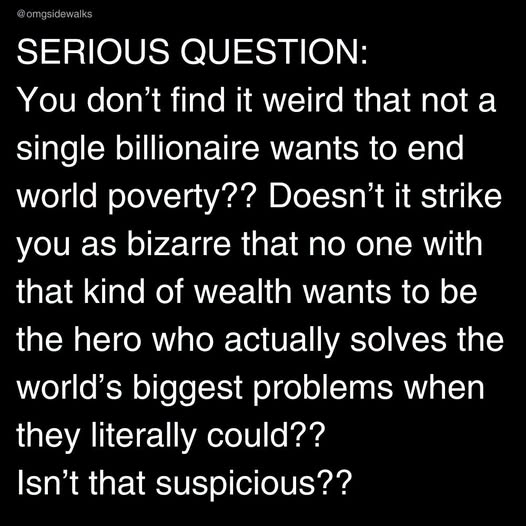
In recent viral social media posts, a provocative question has captured widespread attention: “Why is it that not a single billionaire has committed to ending world poverty?” This simple yet powerful query challenges the often-held assumption that the world’s wealthiest individuals have the resources and influence to make a monumental difference—yet, according to many critics, they haven’t done enough.
The social media post, shared by users @omg and @omgsidewalk, highlights a compelling paradox: despite the staggering fortunes amassed by billionaires such as Elon Musk, Jeff Bezos, Bernard Arnault, and others, global poverty persists at disturbingly high levels. According to the World Bank, over 700 million people live in extreme poverty, surviving on less than $1.90 per day. It raises a fundamental question: What is preventing these wealthy individuals from using their fortunes to eradicate poverty entirely?
Several theories research this phenomenon. Some argue that the concentration of wealth in the hands of a few makes it difficult for such wealth to trickle down efficiently or equitably. Others suggest that billionaires often prioritize investments that yield high returns rather than donations toward global poverty alleviation. Critics point out that much of their wealth is tied up in stocks, private holdings, and assets that are not readily accessible for charitable purposes.
Additionally, many advocate that the lack of a unified, transparent effort by billionaires undermines progress. Unlike governments or international organizations which are somewhat accountable to the public, much of billionaire philanthropy remains voluntary and inconsistent. Although some, like Bill Gates and Warren Buffett, have pledged significant portions of their wealth to philanthropic causes, critics argue that this remains insignificant compared to the scale of the problem.
It’s worth noting that some billionaires do contribute to global causes. However, critics argue that their efforts are often modest relative to their total wealth and that systemic changes—such as reforming tax policies, closing tax havens, and addressing economic inequality—would have a more substantial impact in reducing global poverty.
This silence or inaction from the world’s wealthiest has sparked a more honest and urgent debate about moral responsibility and systemic change. If billionaires claim to be the “creme de la creme” of wealth, shouldn’t they be leading the charge to address the most pressing humanitarian crises? The social media question captures that sentiment and challenges society to reconsider the roles, responsibilities, and potential of the ultra-wealthy in shaping a fairer world.
Ultimately, the viral question invites us all to reflect: Are we satisfied with promises of future philanthropy, or must more be done now — collectively and by those wielding the most power?