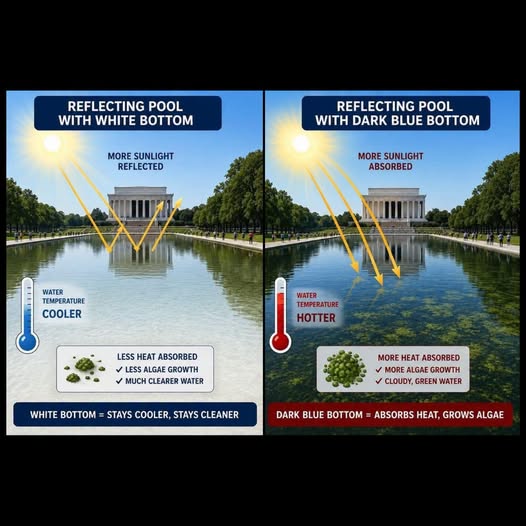
In the world of swimming pools and reflecting spaces, the color of the pool’s bottom isn’t just a design choice—it’s a scientific factor influencing heat absorption and light reflection. A viral social media post highlighting the differences between pools with white versus dark blue bottoms has sparked widespread curiosity about how color impacts water temperature and sunlight reflection.
According to the image shared online, pools with a **white bottom** reflect more sunlight, resulting in a brighter appearance but less heat absorption. Conversely, pools with a **dark blue bottom** absorb more sunlight, leading to increased water heating. This simple yet intriguing observation stems from fundamental principles of physics—specifically, how surfaces reflect and absorb light.
When sunlight hits a surface, a portion of the light is reflected, while the other is absorbed. White surfaces reflect most of the incoming light, keeping the area cooler and brighter. This is why white roads or roofs are used in hot climates—to reflect sunlight and reduce heat absorption. On the flip side, dark-colored surfaces like dark blue pool bottoms absorb more light, converting it into heat, thereby raising the water temperature.
This principle isn’t just academic; it has practical implications for pool owners, landscapers, and even planetary science enthusiasts. For instance, choosing a darker pool bottom can be a strategic decision in colder climates to maximize heating efficiency, while lighter colors are favored in hotter regions to keep water temperatures lower and more comfortable.
Beyond thermal effects, the color also impacts aesthetic and environmental factors. Pools with darker bottoms often appear more vibrant and inviting but may require extra maintenance to prevent algae growth, which thrives in warmer, darker environments. White-bottom pools, while less heat-absorptive, tend to stay cooler and reduce water evaporation—a key consideration for regions facing water scarcity.
Understanding these effects also extends to larger-scale environmental considerations, such as urban heat islands and solar energy collection. Researchers continue to study how surface colors influence local climates and energy efficiency, illustrating that color choice affects more than just visual appeal.
So, next time you’re designing or choosing a pool, consider how the color of the bottom might influence your water temperature and sunlight reflection. It’s a perfect example of how simple visual choices can have measurable physical effects, blending aesthetics with scientific principles for smarter, more sustainable decisions.
Where to Learn More
- Reflective Roofs and Urban Heat: How Color Affects Sunlight Reflection – U.S. Department of Energy
- Light Absorption and Heat Dynamics of Pool Bottom Colors: A Scientific Study – ScienceDirect
- Solar Absorption by Different Surfaces: Implications for Climate and Environment – National Park Service
- How Surface Color Contributes to Urban Heat Islands – The New York Times