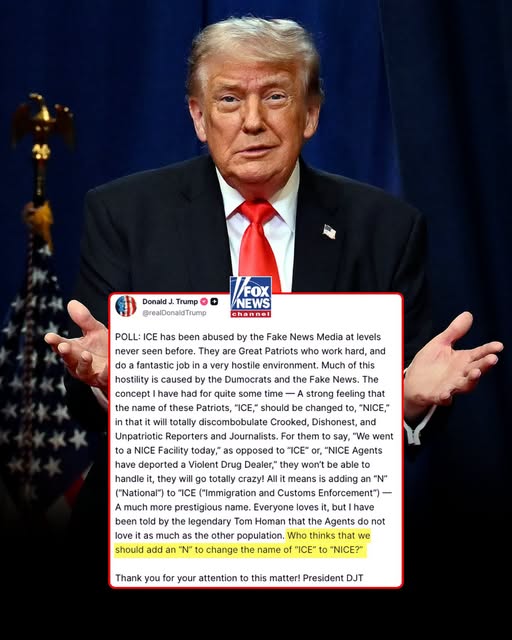
Amid ongoing discussions about immigration enforcement and border security, President Donald Trump has proposed a provocative idea that has ignited social media debates nationwide: renaming Immigration and Customs Enforcement (ICE) to “NICE”.
The proposal surfaced when the President took to his official social media channels, tweeting that changing the agency’s name to “NICE”—which stands for National Immigration and Customs Enforcement—would serve as a clever political move and perhaps even a way to better convey the agency’s duties. Trump also suggested that this rebranding could potentially upset critics, stating that “crooked, dishonest, and unpatriotic reporters and journalists” would find the new acronym “totally crazy.”
While the idea appears tongue-in-cheek on the surface, it has sparked a heated response online. Supporters argue that such a name change could humanize the agency, shifting public perception away from the often controversial enforcement actions associated with ICE and towards a more approachable image. Conversely, critics view the proposal as a political stunt with little substantive impact on immigration policy or enforcement.
Reactions from social media users have ranged from amusement to outrage. Some users have praised the president for his humor, while others dismiss the move as trivial and dismissive of the serious issues surrounding immigration enforcement. Many immigration advocates and political analysts see the suggestion as an attempt at satire or a strategic distraction amid broader debates on immigration reform.
Legal and policy experts note that renaming a federal agency is not a simple matter. It would require legislative approval, adjustments to official documentation, and potential rebranding efforts across numerous government platforms. The process could take months or even years, further complicating the practicality of the idea.
Beyond the humorous surface, the episode underscores ongoing tensions in the national conversation about immigration enforcement, agency transparency, and political branding. Whether or not the name change becomes reality, it has undeniably made a splash on social media, illustrating how even a playful suggestion can turn into a symbolic battleground.
As the debate continues, many are watching to see if this lighthearted proposal will influence future discussions on immigration policy or if it remains simply a viral moment crafted to spark conversation—something President Trump has mastered throughout his political career.