
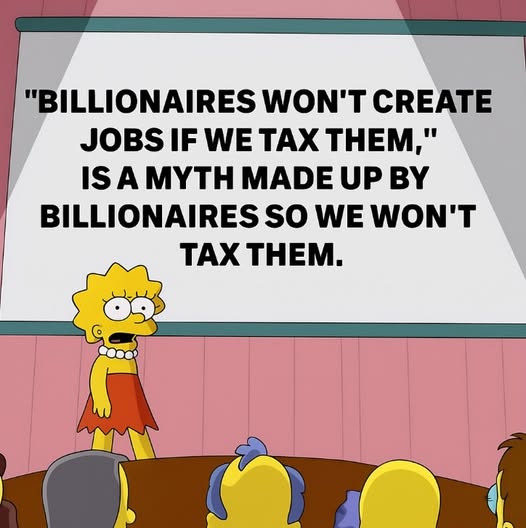
In recent social media debates, a widely circulated graphic claims, “BILLIONAIRES WON’T CREATE JOBS IF WE TAX THEM,” asserting this as a core reason to oppose higher taxes on the ultra-wealthy. However, this popular message is a myth that clouds the complex realities of economic growth, income inequality, and government policy. Experts are warning that dismissing the role of fair taxation dismisses an essential tool for building a more equitable economy.
The graphic, often accompanied by images of stacks of cash and bold text, suggests that taxing billionaires would kill jobs and hurt overall economic progress. The narrative hinges on the idea that wealthy individuals and corporations are the primary engines of employment and innovation, so taxing them more would undermine those efforts. While this messaging resonates emotionally with many, it oversimplifies how economic growth actually occurs.
Economists and policy analysts point out that the myth is rooted in a distorted view propagated by some wealthy interests to maintain low tax rates. Historically, countries that have implemented progressive tax policies and invested in public services, infrastructure, and education have seen strong, sustainable economic growth. Conversely, exorbitant wealth concentration in the hands of a few without adequate public investment can hinder overall societal well-being and create economic stagnation.
Research indicates that tax revenues from the wealthy can be used to fund vital services that support economic stability and growth—such as healthcare, education, and infrastructure. Rather than discouraging businesses, fair taxation can foster a more competitive, innovative economy by enabling a healthier, more productive workforce. Studies show that high levels of inequality can lead to economic volatility, reduced consumer spending, and social unrest—all harmful to long-term growth.
Meanwhile, the argument that billionaires are the sole creators of jobs ignores the vital role of small businesses, entrepreneurs, and a thriving middle class. Moreover, many studies show that tax progressivity does not significantly impact job creation. Countries with robust tax systems, such as Scandinavia, maintain high living standards and strong economies.
In reality, billionaires and corporations often benefit from public investments—and many more are advocating for a shift in blame from government revenue to tax fairness. Progressive tax policies are increasingly seen not as a burden, but as a means to ensure economic stability, reduce inequality, and fund the essential infrastructure that supports genuine job creation.
As the conversation continues to popularize myth-based narratives, experts urge the public to critically evaluate information and seek comprehensive economic data before accepting simplified claims. Fair tax policies are integral not only for equitable society but also for sustainable economic prosperity in the long run.
Where to Learn More
- The Economics of Taxation – The Economist
- Economic Growth and Inequality – Institute for Policy Studies
- Tax Reform and Economic Growth – OECD
- The Case Against Wealth Tax – Cato Institute